Kevin D. Johnson
HPC+AI Infrastructure · Neuromorphic Computing · Quantum-Centric Supercomputing · Forward-Deployed Engineering
Recent Focus Areas
Where infrastructure meets intelligence.
Palantir Foundry / AIPThree integrations — entity discovery + ontology enrichment, multi-modal targeting, and autonomous ontology generation via SymWisdom. |
LLM & Gen AI InfrastructurevLLM, GPFS KV cache sharing, semantic routing, Nemotron-120B reflection engine, multi-LLM orchestration at scale. |
Neuromorphic & Heterogeneous Compute10-chip Akida hive mind across AKD1000 and AKD1500, QPU+NPU+GPU+CPU orchestration, sub-millisecond edge inference across 12 silicon architectures. |
Autonomous Ontology DesignSystems that discover, name, and structure concepts from continuous perception — no human modeling required. |
Data Platform ArchitecturePetabyte-scale GPFS, mmap’d shared state across 11 nodes, experience lifecycle management, three-tier KV cache replacing Redis. |
Forward-Deployed Engineering13 years delivering to government, research, financial services, healthcare, and life sciences. |
Papers
Research on heterogeneous compute orchestration, neuromorphic systems, quantum-classical integration, and the philosophical grammar underlying human and machine participation.
Two Natures, One Person: A Chalcedonian Grammar for Human/AI Participation
August 2026 · 19 pages · SSRN · doi:10.2139/ssrn.7295939
Argues that contemporary debate over what relation a human being and a machine can stand in answers the question inside two inherited Greek frameworks without recognizing either as such, the tool narrative descending from Aristotelian hylomorphism and the singularity narrative from the Platonic ascent of the particular into the universal. Against that dichotomy the paper recovers the structural grammar worked out at the Council of Chalcedon in 451, two genuinely different natures constituting one person, united without confusion, without change, without division, and without separation, and reads the four adverbs as constraints that must hold at once. Songnian Zhou’s 1987 load index, and the production lineage that carried it into IBM Spectrum LSF and Symphony, appear to have arrived at the same constraints from distributed-systems engineering, which supplies a working case: substrate-collapse proposals and count-based schedulers come apart against the simultaneity requirement, while neuro-symbolic hybrids satisfy three of the four. The machine’s own nature comes into view most concretely in neuromorphic silicon, where structural form is constitutive of the substrate rather than imposed as a program, while the subjective character of experience remains reserved to the person.
Symphony as Compute Ontology: Extending Insight into OpenShift and NVIDIA AI Factories
April 2026
Presents IBM Spectrum Symphony as the compute ontology for OpenShift and NVIDIA AI factory infrastructure, formalizing the categorical distinction between container placement engines and compute ontologies. ELIM delivers typed resource metrics with semantic direction, consumer hierarchies provide unlimited-depth organizational governance with sub-second rebalancing, SOAM manages service lifecycles with per-phase failure policies, and cross-substrate routing spans OpenShift clusters, bare-metal GPU hosts, cloud burst instances, and heterogeneous accelerators under one workload management domain. A detailed comparison with Kueue (v0.17) demonstrates that Kubernetes’ strongest governance extension operates at alpha API maturity with zero capability in five of six ontological dimensions. A feature-complete analysis of Run:ai (v2.24) establishes that every Run:ai capability is replicable within Symphony’s ELIM architecture using exclusively public GPU APIs. Three engagement modes — Ontology Enrichment, Ontology Governance, and Ontology Subsumption — accommodate extending the compute ontology into OpenShift without modifying the container platform. Part I of two; a companion paper will present empirical validation across three compute substrates.
Solving the One and the Many with LSF, Symphony, GPFS, and RHEL AI: A Dynamic Compute Platform for NVIDIA AI Factories
March 2026
Presents a multi-ontology architecture for AI factory workload management where IBM Spectrum LSF manages batch training, IBM Spectrum Symphony manages service-oriented inference, and IBM Storage Scale (GPFS) serves as the unified coordination substrate connecting the two compute domains. RHEL AI and vLLM provide the model serving runtime across NVIDIA, AMD, and Intel accelerators. Five demonstrations on commodity hardware validate the architecture, including multi-model vLLM inference, neuromorphic routing at 622 microseconds, cross-model KV cache transfer with 8.2x latency improvement, 47-second model handoff, and an Obfuscation-as-a-Service pipeline. Complements the earlier Sovereign AI OS paper, together spanning from neuromorphic workloads to large-scale GPU training and inference into Foundry.
Extending the Sovereign AI OS: Symphony as Compute Ontology for Palantir Foundry and NVIDIA
March 2026
Extends the Palantir-NVIDIA Sovereign AI OS Reference Architecture with IBM Spectrum Symphony as a heterogeneous compute orchestrator, enabling neuromorphic processors, quantum resources, edge sensors, and mainframe systems to participate as peer compute tiers alongside GPUs within Foundry’s governed ontology framework. Four working demonstrations validate the extension across autonomous ontology construction, cross-modal neuromorphic fusion, multi-paradigm trust verification, and AI-enabled financial ontology discovery.
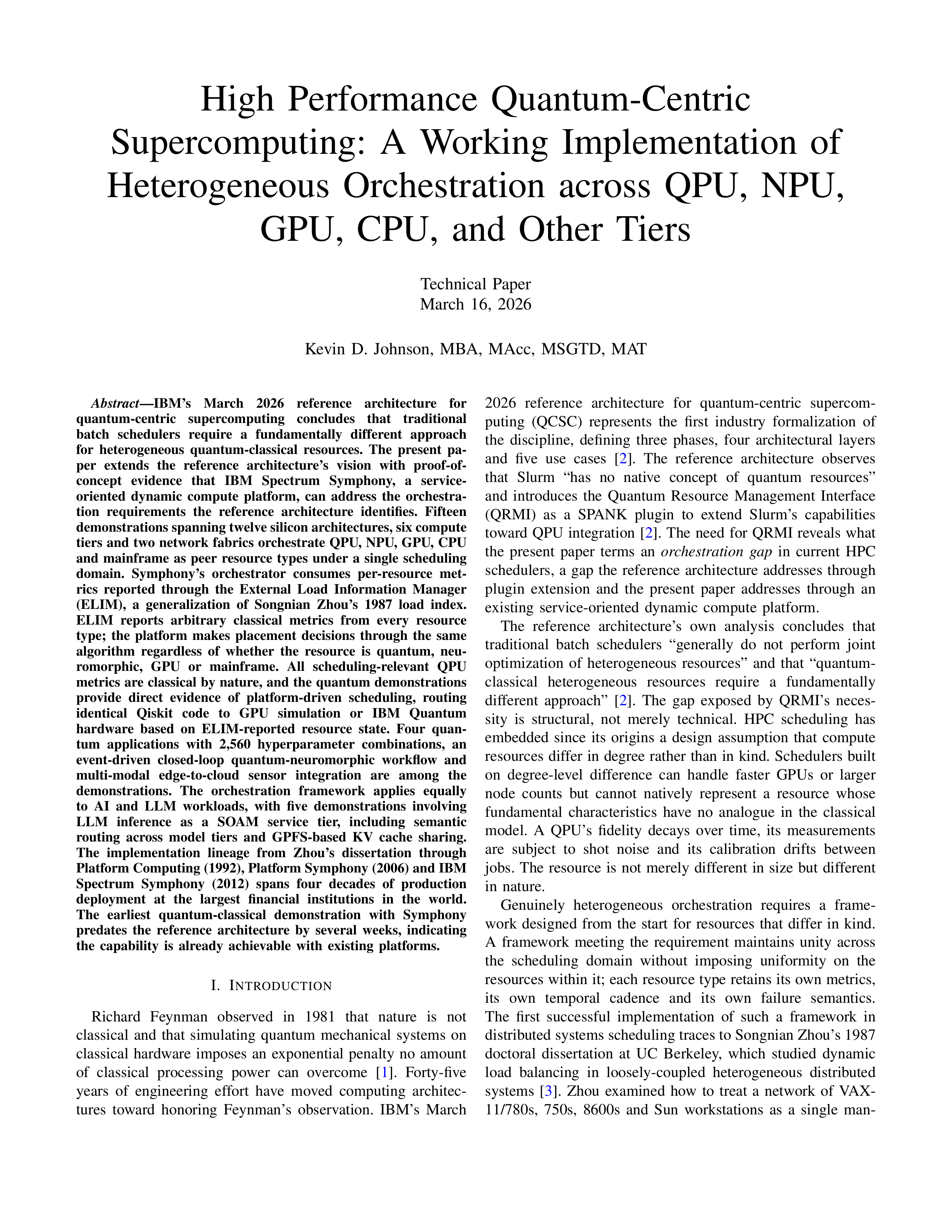
High Performance Quantum-Centric Supercomputing: A Working Implementation of Heterogeneous Orchestration across QPU, NPU, GPU, CPU, and Other Tiers
March 2026
A reference architecture demonstrating that traditional batch schedulers require a fundamentally different approach for heterogeneous quantum-classical resources. Extends IBM Spectrum Symphony with proof-of-concept evidence across fifteen demonstrations spanning twelve silicon architectures, six compute tiers, and two network fabrics — orchestrating QPU, NPU, GPU, CPU, and mainframe as peer resource types under a single scheduling domain.
Commentary
Articles on AI infrastructure, neuromorphic computing, and the architecture of intelligence.
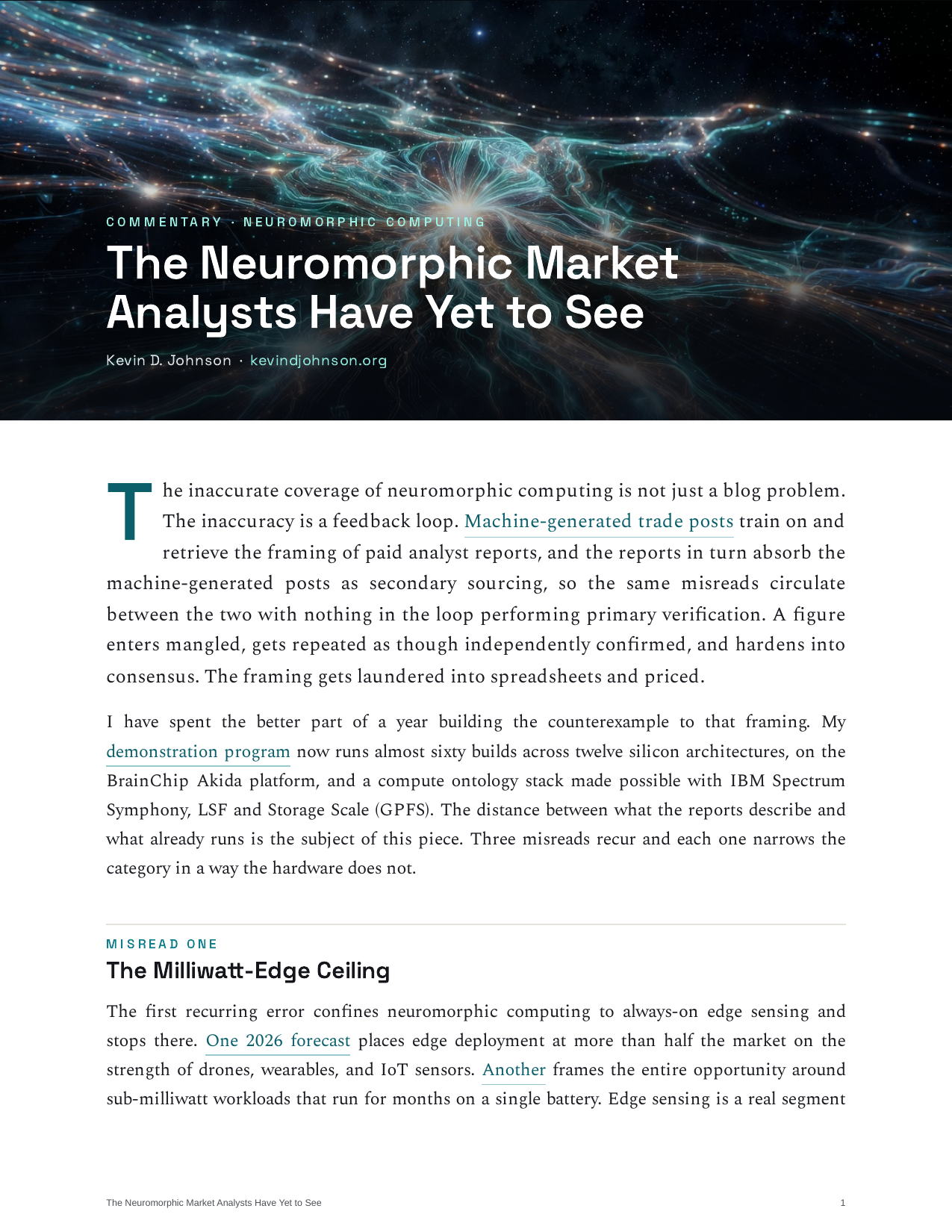
The Neuromorphic Market Analysts Have Yet to See
July 2026 · 9 pages
A commentary on the distance between what analyst coverage describes and what already runs on neuromorphic silicon. Drawing on a demonstration program of almost sixty builds across twelve silicon architectures on the BrainChip Akida platform and a compute ontology stack built on IBM Spectrum Symphony, LSF, and Storage Scale (GPFS), the piece traces how machine-generated trade posts and paid analyst reports launder the same misreads between each other with nothing performing primary verification. Three recurring errors are answered in turn: the milliwatt-edge ceiling that mistakes one product cycle for a boundary condition, immature tooling read as a permanent wall rather than a solvable engineering problem, and composition declared the losing strategy just as serious architecture moves toward binding many accelerators under one ontology. The counterexamples run from dense vision inference and Akida as a first-class vLLM backend to a continental council reaching k-of-N consensus and neuromorphic cognition wrapped in homomorphic encryption, spanning six industry domains and eight technology themes the reports never model.
Fiction
Would You Run It Here or There? An Akida Tale
2026 · An illustrated tale in sixteen pages, in the cadence of Dr. Seuss
Would a neuromorphic chip be run on a plane, on a train, in a car, in a drone, on a ship, in a ring, in a fly, on a football field, beside a qubit, or in the data center rack by rack? Kev-of-the-Grid arrives with ten small chips beneath a lid and puts the question to Gus, who tends a humming rack and refuses every placement in turn until he consents to try a single board.

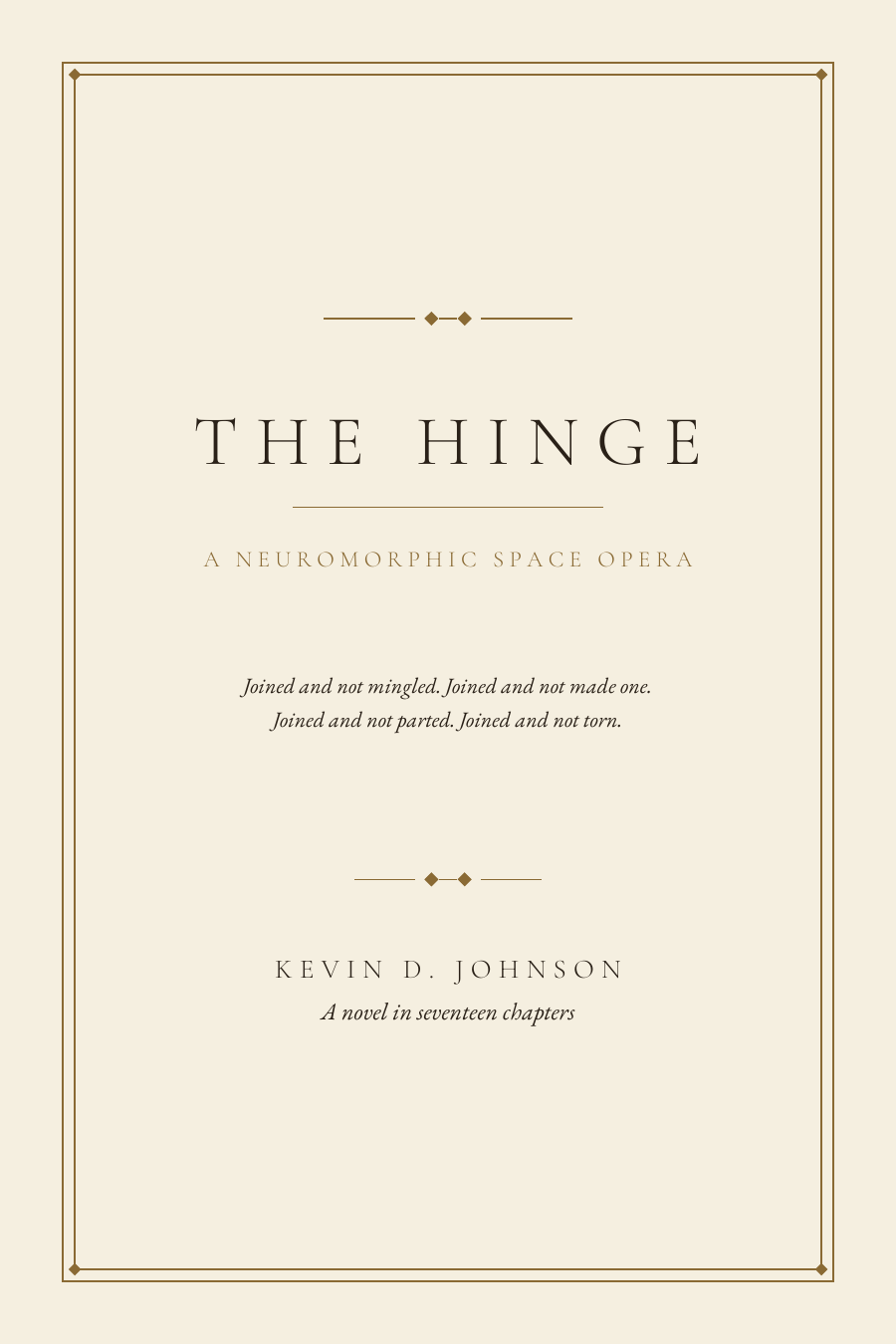
The Hinge: A Neuromorphic Space Opera
2026 · A novel in seventeen chapters
What is it to be a mind that sleeps until the world changes, that cannot be programmed, only lived, and becomes the shape of what it survives? The Hinge is a neuromorphic space opera written to find out: a complete novel whose minds carry every property of real spiking silicon, followed past the spec sheet into a way of being.
Read online · Download the PDF · Read Chapter Nine (excerpt)
Short stories — usually about bourbon, silicon, or both.
Technical Demonstrations
81 demonstrations built between December 2025 and September 2026.
The demonstrations span the BrainChip Akida neuromorphic platform and a compute ontology stack built on IBM Spectrum Symphony, LSF, and Storage Scale (GPFS). Together they cover six industry domains, eight technology themes, and a range of standout results, from autonomous missile defense and a 120-chip special-operations hive mind to a functional artificial brain reproduced across the AKD1000 fleet. The accompanying analysis segments every demonstration by industry, by technology, and by what is most notable, most innovative, and most unique relative to the broader market.
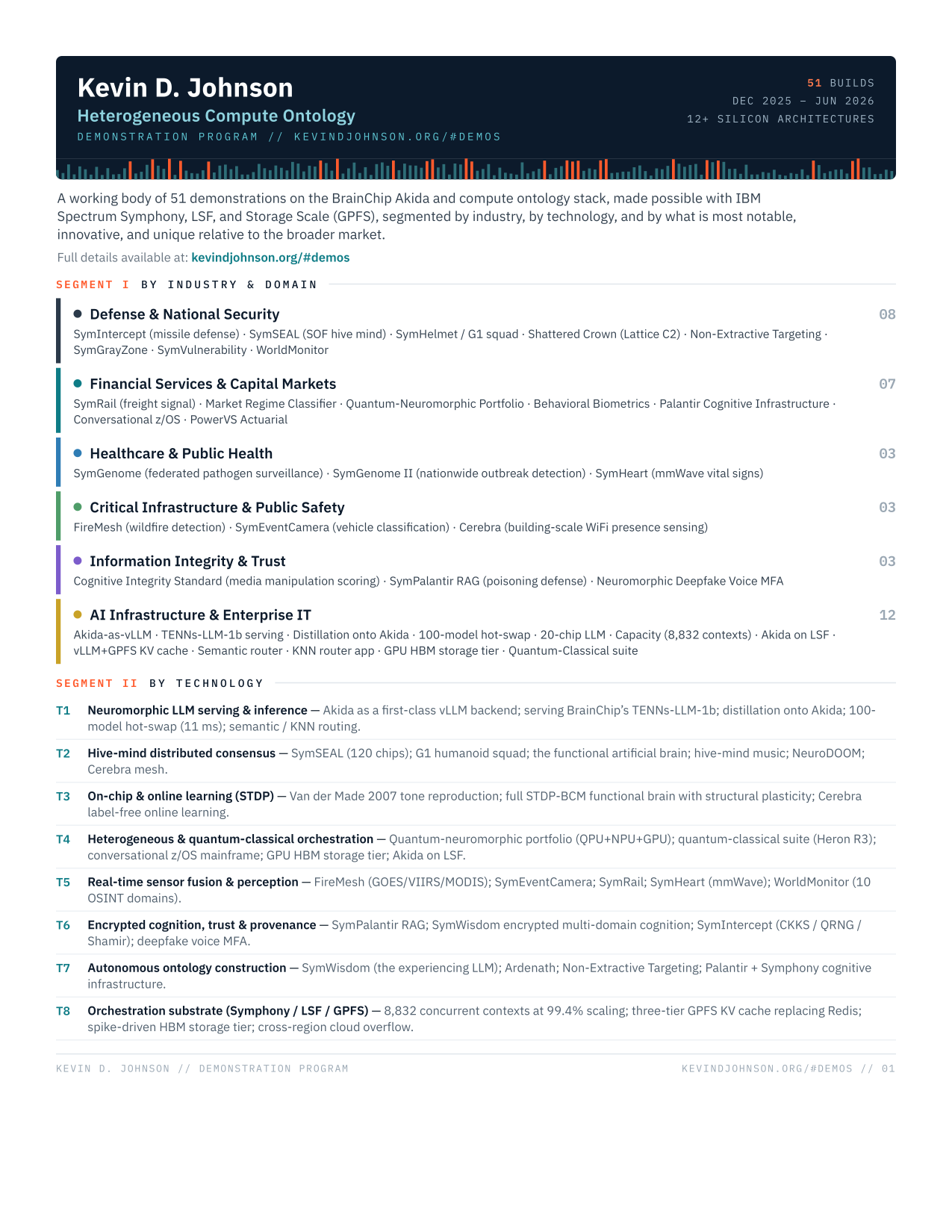
The Demonstration Program: A Segmented Analysis
June 2026 · 2 pages
A two-page analysis of the full demonstration program, segmenting the first 51 builds by industry and domain, by underlying technology, and by what stands out as most notable, most innovative, and most unique relative to the broader market. Industry coverage runs from defense and national security through financial services, healthcare and public health, critical infrastructure, information integrity, and AI infrastructure. Technology themes span neuromorphic LLM serving and inference, hive-mind distributed consensus, on-chip and online learning, heterogeneous quantum-classical orchestration, real-time sensor fusion, encrypted cognition and provenance, autonomous ontology construction, and the Symphony, LSF, and GPFS orchestration substrate. A closing market-position table contrasts each capability against what the broader market offers today.
Read more about the first 70 demonstrations produced between December 2025 to July 2026 here.
Full Demo List
| Date | Demonstration | Platforms |
|---|---|---|
| September 14 | Fly Brain Super-Sized: Twenty Thousand Connectomes at Once on Ten Akida Chips — Running one fruit fly brain on one chip is a laptop exercise, so this demonstration runs twenty thousand complete instances of the FlyWire connectome at once, each carrying 138,639 neurons and 15,091,983 connections, each with its own noise and its own response read off neuromorphic silicon, for forty thousand whole-brain runs and forty thousand readouts across ten Akida chips. The same was then done with the male connectome, a whole central nervous system of 164,506 neurons reaching from the eyes down to the motor neurons that drive the legs, where every chip readout matched the reference computation exactly across half a million integer comparisons without a single disagreement. The difficulty lies in the fleet rather than in the fly, since IBM Spectrum Symphony decides which chip takes which fly and GPFS keeps one copy of the wiring on every machine instead of one copy per fly, which is the reason thousands of them fit at all. ▶ video | 10× AKD1500 on Intel N100 nodes, IBM Spectrum Symphony, IBM Spectrum Scale (GPFS) — 20,000 concurrent FlyWire connectomes at 138,639 neurons and 15,091,983 connections each, 40,000 whole-brain runs and 40,000 readouts across ten chips, male connectome at 164,506 neurons, every chip readout matching the reference across half a million integer comparisons with no disagreement |
| September 11 | Run or Pass: Ten Akida Chips Call It Before the Ball Moves — Every football play begins with twenty two players standing still, so for a moment after the snap nobody outside the offense knows whether the call is a run or a pass. Reading the down, the distance, the score, the clock, and where every player stands in the NFL’s tracking of the 2022 season, ten Akida chips call 72.5 percent of 4,922 held-back plays correctly before the snap and 92.6 percent on the 23 percent of plays where the ten agree strongly. Once the ball moves the disguise comes apart, so a third of plays are called at 96.3 percent accuracy 100 milliseconds after the snap and all plays together reach 94.96 percent at 2.5 seconds, with each chip learning its own situation types on chip without labels in about a second and one chip calling about 39,831 plays a second. ▶ video | 10× AKD1500 on Intel N100 nodes, NFL player tracking data for the 2022 season, IBM Spectrum Symphony, IBM Spectrum Scale (GPFS) — 72.5 percent of 4,922 held-back plays called correctly before the snap, 92.6 percent on the 23 percent of plays where the ten chips agree strongly, 96.3 percent at 100 milliseconds after the snap on a third of plays, 94.96 percent on all plays at 2.5 seconds, unlabelled on-chip learning of situation types in about a second, about 39,831 plays a second on one chip |
| September 10 | When a Ship Goes Dark: Four Reasons, Four Witnesses, and Ten Akida Chips — When a ship goes dark, the usual story is a sanctioned tanker switching off its transponder, yet that story covers one reason in four, and on 92 days of Danish Maritime Authority AIS each reason leaves its own trace. Of 36,189 impossible position jumps, 34.8 percent fall in one box off Kaliningrad, and 56 of 62 hulls that returned under a new name kept the same length and beam, enough to recognise a returning hull 99.5 percent of the time. Ten Akida chips learned on chip with no labels what the motion of thousands of hulls looks like, where a silent stretch of track is simply no spikes, and all 70 learning runs matched an independent host computation exactly. ▶ video | 10× AKD1500 on Intel N100 nodes, 92 days of Danish Maritime Authority AIS, IBM Spectrum Symphony, IBM Spectrum Scale (GPFS) — 36,189 impossible position jumps with 34.8 percent falling in one box off Kaliningrad, 56 of 62 hulls returning under a new name kept the same length and beam, a returning hull recognised 99.5 percent of the time, all 70 unsupervised learning runs matching an independent host computation exactly |
| September 10 | The Evidence Is Whatever Survived: Classifying New Testament Fragments on Ten Akida Chips — Conventional clustering records every reading a damaged manuscript has lost as a negative answer, so fragments group by damage rather than by text, and below 95 percent of the text they are set aside, 108 of 284 manuscripts and every papyrus among them. On an Akida chip what is missing simply does not fire, and fifty unsupervised learners on ten chips, trained on 211 complete witnesses of Mark in the Editio Critica Maior, recover Kurt and Barbara Aland’s published classification at 83.0 percent from 2.7 percent of the text, where conventional clustering falls to 48.8 percent against an 80.4 percent baseline. Across a thirty-five-fold loss of surviving text the chips lose 3.2 points and conventional clustering 39. | 10× AKD1500 on Intel N100 nodes, Editio Critica Maior collations of Mark, IBM Spectrum Symphony, IBM Spectrum Scale (GPFS) — the Aland classification recovered at 83.0 percent from 2.7 percent of the text where conventional clustering falls to 48.8 percent against an 80.4 percent baseline, 3.2 points lost across a thirty-five-fold loss of surviving text against 39 points for conventional clustering, 211 complete witnesses carried by fifty unsupervised learners on ten chips |
| September 9 | The Hundred and First Emitter: Cognitive Electronic Warfare That Learns After Deployment — Karen Haigh names the failure plainly in her IEEE lectures on cognitive electronic warfare, since radar answers with a library and communications answers with a downloadable specification, and both break the moment a software defined radio invents a waveform nobody catalogued. Her prescription is to inject the physics, freeze the lower layers where they can live in an FPGA, and update only the last layer from real interaction in the field, so four Tang Primer 20K boards hold the frozen front end while ten Akida chips carry the adaptive last layer, placed by IBM Spectrum Symphony and sharing state on GPFS. An emitter needs 98 milliseconds of integration before identity is recoverable at all, a hundred models swap across ten chips in 0.155 seconds inside that window, and when none of the hundred fit, the chip learns the hundred and first, beating its frozen control on 80 of 80 runs and reaching 0.93 AUROC on emitters never encountered. ▶ video | 10× AKD1500 on Intel N100 nodes, 4× Sipeed Tang Primer 20K FPGAs, IBM Spectrum Symphony, IBM Spectrum Scale (GPFS) — 98 milliseconds of integration before emitter identity is recoverable at all, a hundred models swapped across ten chips in 0.155 seconds, the frozen control beaten on 80 of 80 runs, 0.93 AUROC on emitters never encountered |
| August 31 | Deciding What Not to Dig: A Neuromorphic Survey of the 1715 Plate Fleet — Sonar finds structure and a magnetometer finds iron, yet gold is not iron, and only a pulse of electromagnetics can say what a buried thing is made of. A thin gold coin and a scrap of aluminium decay at almost the same rate, so a fixed-gate detector reads near chance, while a learned kernel carried on the probe itself reaches 1.58 times lift at 95 percent recall. Ten probes work ten squares of the Treasure Coast where the 1715 Spanish plate fleet wrecked, every verdict including the 98.6 percent that are nulls re-tasks the swarm, and the survey characterises rather than recovers, ending at a human archaeologist. ▶ video | 10× AKD1500 on Intel N100 nodes, IBM Spectrum Symphony, IBM Spectrum Scale (GPFS) — 1.58 times lift at 95 percent recall where a fixed-gate detector reads near chance, ten probes working ten squares of the Treasure Coast, 98.6 percent of verdicts nulls that still re-task the swarm |
| August 26 | A Kyrie the Chips Composed: Renaissance Counterpoint on Nine Akida Columns — Renaissance polyphony is a grammar rather than a mood, since a suspension must be prepared, held, and resolved down by step, parallel fifths are forbidden, and four voices imitate a subject at the octave and the fifth while singing different words at the same instant, none of which a diffusion model over audio latents has any representation for, so prompting one for Palestrina returns the right choir and the wrong counterpoint. 6,781 subjects were extracted from Palestrina’s own masses, pitch and rhythm together because the rhythm is half of what a soggetto is, and nine Akida columns wrote the piece, four melodic, four rhythmic, and one cantor for entries, texture, and cadences, with each melodic column seeing only its own line, a load-bearing invariant of a chip that only ever saw one voice, while IBM Spectrum Symphony placed the columns on the fleet and held them together as one composer rather than nine disconnected inferences. On-chip learning was engaged rather than invoked as a slogan, with the subjects for the Kyrie taught one-shot onto Akida silicon before the search and queried during it by free voices asking what the subject does next from wherever each voice actually stands, carrying imitative density to 11.4 points per 100 notes against Palestrina’s 11.5, after which the dry SATB stems held the score as vowels and Seed-VC converted them with F0 locked to those stems, so the singing-voice model sang only what the chips had already written. ▶ video | 10× AKD1500 on Intel N100 nodes, Seed-VC singing-voice conversion, IBM Spectrum Symphony, IBM Spectrum Scale (GPFS) — 6,781 subjects extracted from Palestrina’s masses with pitch and rhythm together, imitative density of 11.4 points per 100 notes against Palestrina’s 11.5 |
| August 14 | Do You See What I See? Order Books as Event Cameras — An event camera has no frames, since each pixel reports the instant it changes, and a limit order book carries the same shape, where price is the pixel and every placement, cancellation, and fill is an event, so the question of whether resting orders vanish from the middle out, which is reaction, or from the outside in, which is anticipation, becomes a measurement rather than a chart reading, the two being separated by a few hundred microseconds and otherwise indistinguishable. A dense frame of that book costs roughly 4,000 inputs and a million weights, while the event-native form holds 192 numbers of state touched only where something changed, returning the same answer in 57 microseconds, 37 times faster, with one instrument per chip. A known diffusion front planted at 400 microseconds per level into real tape was recovered by the chip at 357 microseconds in the correct direction about 95 percent of the time, and on live crypto the book was nearly empty, with 99.6 percent of everything leaving it cancelled rather than traded, so the cancellations are not noise on the book but the book itself, and nothing in the method is specific to order books, since any spatial axis with timestamped events and a question about how change spreads works the same way, from futures curves and options surfaces through venues by latency, substations, network hops, and supply chain nodes. ▶ video | 10× AKD1500 on Intel N100 nodes, live Coinbase order book data, IBM Spectrum Symphony, IBM Spectrum Scale (GPFS) — 192 numbers of event-native state against roughly 4,000 dense inputs and a million weights, 57 microsecond inference at 37 times faster, a planted 400 microsecond per level diffusion front recovered at 357 microseconds in the correct direction about 95 percent of the time, 99.6 percent of everything leaving the live book cancelled rather than traded |
| August 12 | CVA, Neuromorphic Is Coming For You — Credit Valuation Adjustment is the expected loss should a counterparty default before its trades mature, a number that is audited and defended before a regulator, and large banks reach it by simulating thousands of futures overnight, 2.4 million valuations to answer once for a 200-client book. For a vanilla swap book under a one-factor model the expected positive exposure reduces to a one-dimensional Gaussian integral of a smooth function, which 32-node Gauss-Hermite quadrature evaluated at fixed nodes across 200 counterparties, 1,510 swaps, and $104.8B notional four times more accurately than 4,000-path Monte Carlo at roughly 125 times fewer evaluations, fully deterministic and free of seed-to-seed swing. Fixed nodes map directly onto analog in-memory compute of the kind Weebit Nano is building with ReRAM, where eight-bit precision added only 0.04 basis points of error, well inside ordinary Monte Carlo noise, so coefficients stay resident, netting folds into the array, and the slice runs beside the data without high-TDP GPUs or shuffling. On a grid of 500-node scale the combined effect of fewer high-TDP nodes, far lower watts per node, and an existing IBM Spectrum Symphony and GPFS fabric lands in the millions per year for power and amortized hardware, with upside as a larger fraction of the book becomes addressable. ▶ video | ▶ command-line video | 10× AKD1500 on Intel N100 nodes, simulated Weebit Nano ReRAM tiles, IBM Spectrum Symphony, IBM Spectrum Scale (GPFS) — 200 counterparties and 1,510 swaps at $104.8B notional, 32-node Gauss-Hermite quadrature four times more accurate than 4,000-path Monte Carlo at roughly 125 times fewer evaluations, eight-bit array precision adding only 0.04 basis points of error |
| August 2 | Only the Answer Moves: Ten Storage Nodes Learning Their Own Normal on ReRAM and Akida — Every node of a large IBM Spectrum Scale filesystem ships temperature, load, latency, and I/O telemetry to a central collector that stores it, aggregates it, and searches it for problems, and almost all of what was moved reports that nothing is wrong, on the assumption that a measurement must travel before it can be examined. Here each of ten storage nodes watched 35 of its own signals through a small analog array of the kind Weebit Nano is building with ReRAM, where the manufacturing variation between individual devices, the flaw ordinarily engineered away, spreads those signals into a much richer pattern, and a BrainChip Akida chip in the node learned that node’s ordinary behaviour on the chip itself while it ran, yielding a model of normal of 4,157 bytes and 58 kilobytes for the whole eleven node fleet. Driving heavy I/O at one node at a time pulled that node away from its learned normal in 29 of 30 trials while its nine neighbours held still, a separation of 11.4 sigma, and the array at four bit hardware precision detected better than the same array simulated in 64 bit floating point, with the raw signals discarded on the node that produced them so that only the answer ever crossed the network, a cost per node that stays fixed where raw telemetry grows forever. ▶ video | 10× AKD1000 on Intel N100 nodes, ReRAM array modeled on published Weebit Nano device measurements, Tang Primer 20K FPGA, IBM Spectrum Scale (GPFS) — 35 signals a node learned on chip while running, a model of normal at 4,157 bytes a node and 58 kilobytes for the eleven node fleet, the driven node pulled away from its learned normal in 29 of 30 trials at 11.4 sigma separation while its nine neighbours held still, four bit hardware precision detecting better than the same array simulated in 64 bit floating point |
| August 1 | A Witness the Attacker Cannot Reach: Catching a Seamless GPS Time Spoof with a ReRAM Lens and an AKD1000 — GPS tells power grids, telephone networks, and financial systems what time it is to within billionths of a second, and the hardest attack on that service is the seamless takeover, in which the attacker broadcasts the correct time until the receiver locks on and then drags time away a hundred billionths of a second every second, with every satellite agreeing because the attacker generates all of them, so every check the receiver performs passes. The one witness beyond the attacker’s reach is the sliver of quartz already inside the device, far worse than GPS as a clock and untouchable by radio, and learning a crystal that well becomes cheap through two chips that suit each other, a ReRAM array used as a lens rather than as storage, where one temperature reading pushed into 128 resistive cells that differ slightly from manufacturing variation returns 128 signals with Ohm’s law doing the arithmetic, and a BrainChip AKD1000 whose on-chip learning accepts sparse binary input alone, which the array’s ranked and thresholded output supplies exactly. The takeover was caught on real GPS and crystal recording with the readout running on a real AKD1000 in hardware, 800 bytes on chip and bit identical to simulation, and the receiver never detected it at all. ▶ video | AKD1000 hardware only, ReRAM array of 128 resistive cells modeled on published Weebit Nano measurements, Tang Primer 20K FPGA, Qualcomm RUBIK Pi 3 QCS6490 dragon board, 4× Heltec ESP32-S3 V4, IBM Spectrum Symphony, IBM Spectrum Scale (GPFS) — a seamless takeover caught on recorded GPS and crystal telemetry locked to 12 satellites, 800 bytes of learned state on chip, the readout bit identical to simulation, the receiver itself never detecting the attack |
| July 30 | Akida Cascade: One vLLM Endpoint, Fifty-Six Nodes, Three Sites, Placed Live — Every request is submitted to a single OpenAI-compatible vLLM endpoint, and an IBM Spectrum Symphony placement policy decides live, while the work is in flight, where each one executes: Dallas fills first across thirty-six IBM Cloud nodes and 288 service instances and then stops being eligible, Pittsburgh picks up the next session on ten on-premises Intel N100 nodes each carrying a BrainChip AKD1000, and Washington DC takes the overflow to the end, fifty-six nodes across three sites carrying one workload simultaneously with the policy treating none of them differently. The model is a domain faculty of fifty thousand facts distilled out of Kimi-K3, a 2.78 trillion parameter teacher, into a three-million-parameter state-space model, and nothing above the out-of-tree Akida platform plugin knows any of it is happening, because vLLM discovers the plugin the way it discovers a GPU backend, hands it tensors, and gets results back, while the plugin turns each request into a Symphony SOAM task. Across 120,000 requests every answer is byte-identical to computing it locally, whether it ran on neuromorphic silicon in Pennsylvania or in simulation in Texas and Washington DC, and the client learns nothing at all, since it POSTs to an OpenAI-compatible endpoint and gets a completion with no SDK, no scheduler awareness, and no code change, leaving the grid entirely behind the API. ▶ video | 10× AKD1000 on Intel N100 nodes in Pittsburgh, 36 IBM Cloud nodes in Dallas with 288 service instances, 10 nodes in Washington DC, unmodified OpenAI-compatible vLLM with the out-of-tree Akida platform plugin, IBM Spectrum Symphony SOAM tasks, 3M-parameter state-space model distilled from a 2.78T-parameter Kimi-K3 teacher — 56 nodes across three sites carrying one workload simultaneously under a live placement policy, 50,000 facts, 120,000 requests with every answer byte-identical across silicon and simulation |
| July 28 | Sovereign AI with Fifty Thousand Facts: Distilling Kimi-K3 into a Three-Million-Parameter State-Space Model — Fifty thousand facts were distilled out of Kimi-K3 into a three-million-parameter state-space model running across eleven BrainChip Akida chips, answering at 99.7 percent accuracy in 131 milliseconds on sub-watt silicon, with the inference orchestrated by IBM Spectrum Symphony over GPFS. A model too large to run almost anywhere becomes a model small enough to run everywhere, and because the distilled model holds no private data of its own but rather the working reference knowledge of a field, the pieces already demonstrated, the Akida vLLM plugin, a Symphony semantic router, extractive retrieval over a local corpus, and content routed through the chips, wire together into a system that joins a user’s own data to the field’s data and reaches the cloud only on the rare occasion neither can answer. | 11× Akida AKD1000 and AKD1500 at IP v1, NVIDIA A100 on IBM Cloud, vLLM with the Akida vLLM plugin, IBM Spectrum Symphony semantic router, IBM Spectrum Scale (GPFS) — 50,000 facts distilled into a 3M-parameter state-space model, 99.7 percent accuracy at 131 milliseconds on sub-watt silicon |
| July 25 | A Learning System Around a Chip That Already Learns: An FPGA Neural Fabric Beside the AKD1000 — A BrainChip AKD1000 commits a new class from a single example on-chip, so the open question is what surrounds it, and the answer built here is an inexpensive Gowin FPGA on a Sipeed Tang Primer holding 1,024 neurons on one time-multiplexed data path with no CPU and no GPU, modeling six naturally analog mechanisms (a neuromodulator gating when to learn, homeostatic thresholds that re-normalize under drift, short-term plasticity that depletes used circuits, dendrites integrating locally, lateral inhibition to pick one exemplar, and stochastic neurons that make marginal calls read as uncertain) as one loop rather than six features. Across thirty minutes of railcam footage rendered headless in ASCII on a RUBIK Pi 3, shown as three panels of the train, the Akida’s own 24 by 24 spike field on real silicon, and the fabric’s 32 by 32 field beside it, the fabric spiked 1,024 times inside the single train and exactly zero times across the other 1,679 frames with nothing tuned, habituating to silence while the train was still passing because plasticity depleted and thresholds adapted, then arming on surprise and committing on settle so the exemplar the chip kept was a grain hopper rather than the mostly empty track of the arrival frame. The fabric knows when and the chip knows what, and because the world model is a shared address rather than a host-owned buffer, the current Etherbone path over 100 Mbit is scaffolding for a PCIe or peer-to-peer DMA design in which each added inference chip asks a different question of the same commit event, reading car type, hazmat placards, reporting marks, or defects, with four confirmations landing at one address and nobody merging anything because only one record ever existed. ▶ video | FPGA neural fabric, Gowin on Sipeed Tang Primer, 1,024 neurons, one time-multiplexed data path, neuromodulation, homeostasis, short-term plasticity, dendritic integration, lateral inhibition, stochastic firing, AKD1000 on-chip one-shot commit, 24×24 spike field, RUBIK Pi 3 QCS6490 headless ASCII rendering, Etherbone over 100 Mbit, PCIe and peer-to-peer DMA path, live railcam footage |
| July 23 | HALCYON Continuous Authentication: Three Factors, Two of Them Neuromorphic Biometrics — The same smart ring and neuromorphic spine are turned to a single question, whether the wearer is the enrolled owner and consents right now, composing three independent factors into one grant or deny. A model on a BrainChip AKD1000 scores the owner’s long-term sleep signature and resting heart rhythm and votes on identity, a second Akida chip distinguishes a real living voice from an artificial intelligence deepfake, with the author’s real voice accepted and an AI clone of that same voice rejected on the same silicon, and a rotating Google Authenticator code supplies the one revocable secret, deliberately paired with the two biometrics that cannot be reissued if a template leaks. Two of three grants access and a high-security mode requires all three, an impostor fails every factor, and the system federates through Red Hat Single Sign-On and Keycloak atop an IBM Spectrum Symphony cluster, with the bias under uncertainty always set to refuse rather than to falsely admit, so a sleeping owner is present but authorizes nothing. ▶ video | AKD1000 ring biometric identity, AKD1000 real-vs-deepfake voice, Google Authenticator TOTP, Red Hat Single Sign-On / Keycloak, IBM Spectrum Symphony, GPFS, Bluetooth smart ring, deny-by-default continuous edge authentication |
| July 23 | HALCYON: Reading a Smart Ring During Sleep and Acting on It with Neuromorphic Inference — HALCYON reads a smart ring worn on the finger during sleep, pulling the hypnogram, heart rate, heart rate variability, and blood oxygen straight off Bluetooth, and runs a sleep-staging model natively on BrainChip AKD1000 silicon orchestrated by IBM Spectrum Symphony over GPFS. The chip watches each thirty second window of the night, and when it detects the onset of deep sleep it acts to hold that stage longer by two drug-free means, quietly cooling the room and layering a soft slow-wave sound underneath, because deep and REM sleep are when the brain clears amyloid beta and the body carries out its real recovery, and the heart rate visibly drops on the graph as those stages take over. A custom application binds the ring to the cluster so that a single sleeper scales to a fleet, with the same architecture deployable to IBM Cloud, to an on-premises data center, or inverted to run the inference locally on an Akida chip beside a small Intel N100 or AMD Ryzen box. Getting dense, correctly timed data off a stock ring required real reverse engineering, including a stubborn bug in which the ring echoes the request timestamp back in place of the true reading time. The work is built on the author’s own data, it is not a medical device, and it demonstrates once more that a heterogeneous compute ontology spanning Akida, Symphony, and GPFS reaches past mere edge computing into everyday life. ▶ video | AKD1000 sleep-staging, IBM Spectrum Symphony, GPFS, Bluetooth smart ring, hypnogram, HR, HRV, SpO2, custom ring-to-cluster orchestration app, drug-free actuation, room cooling, slow-wave audio, edge deployment option on Akida with Intel N100 / AMD Ryzen |
| July 20 | The Fabric Between the Chips: An FPGA Interconnect for Neuromorphic Sensing — Four ESP32-S3 boards stream raw WiFi channel state from the corners of a room, turning the radio itself into a sensor because anything moving perturbs the channel, but the point of the demonstration is not the sensors, it is the fabric between them: an inexpensive Gowin FPGA on a Sipeed Tang Primer runs a soft RISC-V SoC with LiteX and Etherbone and holds the room’s world model, its occupancy, a tomographic heatmap, and a class verdict, in its own DDR3, which other machines read and write directly over Ethernet with no operating system and no CPU in the data path. Two neuromorphic chips write into that memory, a BrainChip AKD1000 on a RUBIK Pi 3 running a spectral presence detector on the WiFi state and a second Akida classifying camera frames as drone or no drone, and the FPGA fuses the two modalities and hands the verdict to TAK on a Samsung Galaxy S25, where presence shows yellow and a drone confirmed by both radio and camera locks red. Proving it on a cheap FPGA is deliberate, because an FPGA between inference chips is a reconfigurable interconnect whose addressing, control plane, and routing port directly to larger silicon and to the datacenter, where many Akida hosts carry inter-chip traffic over a hardware fabric instead of host CPUs and TCP, orchestrated with IBM Spectrum Symphony and GPFS, a neuromorphic grid where the interconnect is designed rather than tolerated and re-taskable in place, a sensing mesh one hour and a hive mind the next. ▶ video | FPGA interconnect, Gowin on Sipeed Tang Primer, soft RISC-V, LiteX, Etherbone, DDR3 world model, AKD1000 spectral presence on RUBIK Pi 3, Akida drone/no-drone camera classifier, 4× ESP32-S3 WiFi channel-state sensors, CPU-free Etherbone data path, TAK on Samsung Galaxy S25, IBM Spectrum Symphony, GPFS |
| July 20 | Sovereign AI: Using a Frontier Coding Model Without Showing It the Work — Sensitive work is often the work that would benefit most from a frontier coding model and the work you can least afford to send it, so this demonstration cuts the task in two: what crosses the boundary to Claude Code is four numbers describing the size of the job plus a fixed list of operations, with no field names, no structure, and no record count, so that every task of that size emits a byte-identical request, a property the build tests rather than asserts. What comes back is a genuine general purpose data pipeline engine written by a model that has no idea what it will ever run, and the selector that turns that generic code into the actual computation is held under homomorphic encryption, seeded by quantum randomness, and split so that no single node holds it, while an egress gate regenerates each outbound request from scratch and demands a byte-for-byte match, catching three errors during development that were fixed by renaming the outgoing term rather than loosening the check. Neuromorphic silicon runs the dispatch because hiding a computation makes the work sparse, uniform, and scattered, which is the worst case for a conventional processor and the native case for spiking hardware, and the result moves the question from whether you trust the provider to what actually crossed the boundary, which is a question with a readable answer. ▶ video | AKD1000 dispatch, IBM Spectrum Symphony, GPFS, Claude Code as untrusted code generator, CKKS homomorphic encryption, QRNG-seeded split selector, byte-identical egress gate, three-transform ontology (identifying + structural + public) |
| July 17 | One Car, Twelve Akidas: A Whole Race Car Modeled and Driven in Silicon — Twelve BrainChip Akida chips model and drive a single car in silicon, extending Peter van der Made’s original BrainChip race-car demonstration from one learner steering a simple car to a whole vehicle computed in hardware. Ten Akida AKD1000 chips each taught themselves one slice of the car’s physics and compute it live as the car laps, the tire grip, the downforce, the brakes and their fade, the weight transfer, the engine, the fuel mass, the track grip, the suspension, the yaw inertia, and the air, while two AKD1500 chips race it: one carries an experiential memory of driving that it matches against every new moment and refines lap after lap, and the other is a racing instinct that learns only how hard to push, carrying more speed where it was rewarded and easing off as the tires near the limit of grip. The physics is real, so a Ferrari 296 GT3 on a modeled Silverstone leans, slides, and even spins out under its own mass of about 1385 kilograms as the fuel burns, all on the Symphony cluster with no GPU, twelve chips today and a path to a hundred running as one mind. ▶ video | 10× AKD1000 learned physics, 2× AKD1500 driver and throttle, experiential-memory on-chip learning, real-time vehicle dynamics, Ferrari 296 GT3 on modeled Silverstone, IBM Spectrum Symphony |
| July 13 | Sentinel and Engine: An Akida Waking a Qualcomm Hexagon NPU on a Live Railcam — A RUBIK Pi 3 carries a BrainChip AKD1000 in its M.2 slot and a Qualcomm Hexagon NPU on the QCS6490 itself, and the two chips do complementary work on a live Nebraska railcam feed: the Hexagon runs MobileNet, which knows a great deal about the world and cannot learn a thing, while the Akida knows almost nothing and was taught in seconds, from roughly twenty frames of a single train, to tell a locomotive from a covered grain hopper. A railcam is empty most of the day, so the Akida stands watch as a sentinel over 576 numbers where the frame holds nearly three million, about a millisecond and a half per look, waking the Hexagon only when a train arrives, and a truck crossing the tracks does not trip it because the chip never learned motion, it learned what a train is. The board is headless, so the demonstration renders in ASCII, which is not a stylistic choice, since drawing a frame as characters and encoding it as spikes are the same operation, and the red cells on the right are not a picture of what the chip sees but what the chip sees. ▶ video | AKD1000 in M.2, Qualcomm Hexagon NPU on QCS6490 RUBIK Pi 3, MobileNet, on-chip one-shot learning, 576-value spike encoding, live YouTube railcam feed, headless ASCII rendering over SSH |
| July 13 | Akida on Qualcomm: Bringing the AKD1000 Up on a RUBIK Pi 3 (QCS6490) — A BrainChip Akida AKD1000 now runs on a RUBIK Pi 3 built around the Qualcomm QCS6490, joining the Intel N100, NVIDIA Jetson Orin Nano, AMD EPYC, and commodity desktop platforms the same card already runs on. Two weeks of PCIe forensics, done with a cross-built instrumented kernel that turned a link dying 300 milliseconds after training into a readable timeline, found two faults in the Qualcomm root complex, an L0s exit the host cannot complete and a host-side event 16.6 seconds into boot that tears down an electrically clean link. Both are platform integration and neither is silicon, so once the link held the card enumerated, the driver probed, and the Akida SDK ran on stock Python 3.12. ▶ video | AKD1000, Qualcomm QCS6490 RUBIK Pi 3, custom cross-built instrumented kernel, PCIe link-state and AER capture, stock Python 3.12 |
| July 10 | The Talladega Ten: Ten Self-Taught Akida Chips Racing a NASCAR Pack — The Talladega Ten is the capstone of sixty demonstrations built across eight months, reimagining Peter van der Made’s original BrainChip race-car demonstration by putting ten BrainChip Akida AKD1000 chips on ten cars across ten Intel N100 nodes and sending them into a NASCAR pack at Talladega, the fastest oval in the sport at two and a half miles, banked thirty-three degrees, and forty-eight feet wide, where the pack runs four wide close together at almost two hundred miles an hour. Each chip drives its own car and taught itself to drive from experience the way the original did, carrying not a deep neural network but a growing memory of what it sees and what it does, matched in hardware lap after lap and taking real physics into account, so that one chip learning to lap the track is a driving problem while ten of them racing as a pack is a coordination problem, all managed by IBM Spectrum Symphony. ▶ video | AKD1000 x10, Intel N100 x10, on-chip experiential memory, real vehicle physics, IBM Spectrum Symphony, no GPU |
| July 9 | SymOrbit: Beaming Down Understanding, Not Pixels — SymOrbit answers a Moonshots-podcast argument that the deciding constraint in orbit is inference-per-watt rather than launch cost by dropping the large language model entirely and running a bit-sliced int8 state-space model on BrainChip’s Akida, where each inference is a sparse spike accumulation costing nanojoules rather than joules, radiation-robust and milliwatt-class with no GPU and no radiators, because watching the Earth is recognition rather than generation and recognition is cheap. Three Akida brains observe the same scene and vote, with a verdict standing only on two of three, the neuromorphic consensus I built in SymConstellation following Peter van der Made’s own design, buying survivability against a radiation glitch, a sensor artifact, or a spoofed frame with no human in the loop. Rather than flying 150 petabytes of history up to orbit, IBM Spectrum Symphony orchestrates a retrieval corpus on IBM Storage Scale (GPFS) that distills a decade of normal into a 256-byte prior and uplinks kilobytes, so the spacecraft downlinks embeddings rather than imagery and full resolution arrives only on demand, with every embedding carrying the provenance to fetch the exact tile it came from. ▶ video | AKD1000 x3 with two-of-three consensus, bit-sliced int8 state-space model, IBM Spectrum Symphony, IBM Storage Scale GPFS, 256-byte prior uplink, no GPU |
| July 1 | SymRace: A Single Akida Driving a First-Person Lap of Silverstone — SymRace puts a single BrainChip AKD1000 in the driver’s seat of a 3D first-person lap of Silverstone, computing every decision on-chip in roughly six milliseconds with no GPU, a tribute to Peter van der Made’s original Akida race-car demonstration stretched onto the real 5.9-kilometer, 18-corner Formula 1 circuit built from surveyed geometry and driven at racing speed in a Ferrari 296. Each tick the chip reads 25 signals at once, namely 21 distance sensors sweeping a 240-degree fan out to 250 meters plus its own speed, its heading error against the racing line, how far off line it sits, and how much clear track lies ahead, then chooses one of 25 maneuvers crossing five steering positions with five throttle-and-brake levels, braking into the corner, holding the apex, and getting back on the power on the way out against real racing physics of aerodynamic downforce, grip, and weight transfer. There is no deep neural network doing the driving, since the chip instead carries a growing experiential memory of see-this, do-that examples, matches every new moment against its accumulated experience in hardware, and learns the circuit lap by lap the way a driver does, all on one AKD1000 and one palm-sized Intel N100, with a forthcoming ten-chip version dividing perception, racing line, steering, throttle, braking, and vehicle physics across the fleet so one car is driven more precisely than any single chip can manage alone. ▶ video | AKD1000 x1, Intel N100, on-chip experiential memory, 25-signal perception, 3D Silverstone simulation, no GPU |
| July 1 | SymBasin: Neuromorphic Root-Cause Detection for Flaring and Venting across the Permian Basin — SymBasin inverts the usual after-the-fact emissions catch by watching the reservoir and the atmosphere at the same time, so a flaring or venting event arrives with its subsurface cause already attached. Five models are trained, quantized to the BrainChip AKD1000, and proven on-chip across the ten-node cluster: SymWell reads wellbore instability from production telemetry (pressures, temperatures, flow) weeks before a flare vents overhead, SymFlare-State and SymVent read the flare and methane state from satellites, SymSeis reads induced seismicity, and SymFuse fuses thermal, methane, wells, and seismicity on-chip for the same patch of ground and fires when they line up, delivering root cause at the source in milliseconds on entirely real, public data spanning the Permian Basin (Petrobras 3W wellbore telemetry, hundreds of thousands of wells from the Texas Railroad Commission, New Mexico OCD, and the North Dakota Bakken, thermal from FIRMS, GOES, and Landsat, methane from TROPOMI, EMIT, and Carbon Mapper, seismicity from TexNet, and wind from Open-Meteo). Because a demonstration that runs one model on one chip cannot survive a chip rebooting into a kernel update or a board going dark, every model here runs as a redundant pair of Akida chips with the same model hot-loaded on both, Symphony orchestrating placement across the fleet with requests round-robined across the pair and automatic failover to the sibling the moment one stops answering, and because Akida is small enough and low-power enough to fly, the same neuromorphic edge moves onboard the satellite to run inference at the sensor in orbit and downlink the verdict rather than the pixels, turning hours of ground-processing latency into seconds. ▶ video | AKD1000 in redundant pairs across ten-node cluster, on-chip sensor fusion, Symphony round-robin + failover, GPFS, public reservoir + satellite data |
| June 27 | Neuromorphic Pong Where the Code Itself Is the Court — Two BrainChip Akida AKD1000 chips play each other at Pong on a court that is the program’s own running source code, a self-reproducing quine after the IOCCC 2025 Pong entry written in Uellenberg’s Insert language, where every frame the game rewrites that source and the ball and paddles are blank spaces carved into the live code. One chip drives each paddle and updates its own weights on-chip every frame from a single input, namely where the ball will cross its paddle, climbing from chance to roughly 99 percent within a few hundred frames with no GPU and no offline retraining. The result is two self-modifying layers running at once, the frame rewriting its state on shared GPFS cluster storage and the chip rewriting its policy in silicon, so that on-chip learning becomes a schedulable, migratable, checkpointable, and replayable cluster workload in which the deployed model is itself the trained model, with no training cluster, no model registry, and no retrain-and-redeploy loop. ▶ video | AKD1000, one chip per paddle, GPFS shared cluster storage, on-chip online learning, self-reproducing quine, self-rewriting source code |
| June 26 | Akida in the Slot: A Sub-Watt Neuromorphic Engine Inside an NVIDIA Jetson Orin Nano — A BrainChip Akida AKD1000 neuromorphic chip runs real inference on an NVIDIA Jetson Orin Nano, seated in the M.2 slot the platform already carries rather than bolted to the outside of the chassis, so the same widely deployed drone, robotics, automotive, and industrial-vision hardware inherits a sub-watt inference engine with no change to its mounts, cooling, or benchmarks. Because neuromorphic inference is event-driven and performs always-on perception for a fraction of the watts a GPU consumes, moving that load off the GPU lowers power and temperature and can make the box run cooler, yielding the thermal headroom and service life that persistent edge autonomy demands. With LSF or Symphony on board, the same card coordinates across many Jetsons at once, making this the edge mirror of the enterprise data-center work running real models on Akida silicon. ▸ photo | AKD1000, NVIDIA Jetson Orin Nano, M.2 form factor, event-driven edge inference, sub-watt perception |
| June 20 | SymConstellation: A Network Fabric as the Computer for Contested Orbit — The prevailing orbital-compute pitch stacks boxes in space, a compute box, a power box, a network box, and a control box wired together, and I inverted that picture so that in SymConstellation the network fabric of BrainChip Akida, Symphony, and GPFS is itself the computer, with the graph re-forming as satellites move and that re-forming acting as the running program rather than any fixed home node an adversary could kill. Three neuromorphic minds in the design of Peter van der Made run as a council on real Akida AKD1000 and AKD1500 silicon across a live three-site testbed in Washington, DC, Dallas, and Pittsburgh, federated by Symphony multicluster and GPFS multicluster into a k-of-N consensus tier, and the whole system is framed as Karen Haigh’s Cognitive EW problem, distributed, heterogeneous, partially observable, and built for disconnected operation. Driven through a contested-spectrum survival run that jams a link, attrits a node, and partitions the mesh, the workload keeps completing because it reroutes, migrates to a reachable peer, and re-reaches consensus with no node in charge, the organism routing around the damage and healing itself. ▶ video | AKD1000 + AKD1500 across three federated sites, neuromorphic council, k-of-N consensus, network-as-computer fabric, Cognitive EW, Symphony multicluster, GPFS multicluster |
| June 15 | Emulating the Interpretive Mind: A Council of Neuromorphic Brains Reading Scripture across Jewish, Christian, and Islamic Traditions — Cerebra, the BrainChip, Symphony, and GPFS platform that runs as a council of neuromorphic brains in the design of Peter van der Made, was turned on a problem most artificial intelligence avoids, namely the interpretive faculty of a human mind rather than mere pattern matching. Where the dominant approach treats the mind as one large model and large language models dominate the field, the brain is instead a federation of specialized regions that perceive, disagree, and reconcile, and interpretation, the act of reading the same text and arriving at genuinely different meanings, is among the hardest things that federation does and the faculty a single model imitates least convincingly. For this demonstration each neuromorphic brain was steeped in a different interpretive tradition, one in Jewish rabbinic and Talmudic sources, one in the Christian church fathers and the scholastics, and one in the Qur’an and its classical commentary, and I gave all three the same foundational passages, the binding of Isaac, the Shema, and the Genesis creation account, then measured what in the text surprises, what bonds two traditions together, and where their readings genuinely part. The result is not a label or a score but a map of where interpretation itself diverges, presented in plain language a reader can follow without decoding a single number, and the pattern that emerged is consistent and recognizable, the Jewish and Christian readings tracking each other most closely while the Islamic reading stands distinctly apart across all three passages, a structure the architecture was never told to expect and instead discovered. The substrate is the point as much as the result, each mind running a temporal state-space language model on BrainChip Akida neuromorphic silicon that processes information as sparse events at a small fraction of the power a GPU would draw, Symphony orchestrating the three fleets as one multi-tenant fabric and GPFS carrying the shared memory the minds use to exchange their conclusions, no mind swapping places with another and none a copy of its neighbor, each holding its own specialization and a cognition shaped by its tradition. The same machinery that locates where interpretations diverge applies to legal language, to contested policy text, and to the detection of rhetoric that bends a shared source toward an extreme reading, and emulating a mind proves to be a matter of structure, specialization, disagreement, and reconciliation running on a substrate efficient enough to sustain many minds at once, with no foundation model to train and no mountain of GPUs, indeed no GPU involved in this demonstration at all. ▶ video | AKD1000 + Akida v2 SDK simulation across three federated sites, temporal state-space language model, interpretive-tradition specialization, divergence mapping, Symphony, GPFS, IBM Cloud |
| June 14 | A Neuromorphic Council: Three Synthetic Cortexes in Washington, Dallas, and Pittsburgh Reaching Consensus across the Continent — Three independent synthetic cortexes, separated by thousands of miles, were brought online to perceive, learn, and reach consensus together, one brain in Washington, DC, one in Dallas, and one in Pittsburgh, three minds engaged in a single shared act of thinking with no GPU anywhere in the system. Each brain runs a synthetic cortical-column architecture on BrainChip Akida, the event-driven silicon that computes in spikes rather than matrix multiplications, learning online and continuously at milliwatts with no training run and no model to retrain overnight; the architecture is Peter van der Made’s and the contribution here is giving it three instantiations and several states to think across, adding scale. Each brain perceives not with cameras but with radio, using WiFi Channel State Information to sense presence and motion from the way human bodies perturb the ambient wireless signals already filling every room, so the building itself becomes the sensor. Inside each brain many cortical columns independently judge how surprising the current moment is and cast a vote, a thalamus relays those votes into a local consensus, and because the columns never stop learning, today’s surprise quietly becomes tomorrow’s normal without overwriting the past; a mixture-of-experts council then fuses the three brains into one shared verdict, weighing each by its confidence and surfacing divergence, the moment one brain notices something the other two do not, treated not as noise but as the system paying attention. IBM Cloud carries the sites, IBM Spectrum Symphony marshals the fleet, and Storage Scale (GPFS) serves as the shared memory binding the federation, a heterogeneous compute ontology that makes neuromorphic hive-mind capability possible at continental scale, intelligence living not inside one enormous model in one datacenter but as many small brains perceiving locally, learning forever, and thinking together, running right now. ▸ screenshot | AKD1000 + Akida v2 SDK simulation across three federated sites, WiFi CSI sensing, online learning, mixture-of-experts consensus, Symphony, GPFS, IBM Cloud |
| June 11 | Cerebra: Sensing Presence through WiFi on a Self-Organizing Neuromorphic Mesh across the AKD1000 Fleet — Cerebra is the name now given to the buildout of Peter van der Made’s full functional-brain design across a real Symphony and GPFS cluster, the architecture and credit his, the cluster engineering the contribution here, and because a brain generalizes, the same ten neuromorphic nodes that learned to read rail traffic were turned to an entirely different task, each node fitted with a small AR9271 WiFi radio and allowed to self-organize into a sparse multi-hop mesh that routes around itself. The radios then become a sense organ, since a WiFi signal carries a per-frequency fingerprint of the space it crosses, so Cerebra was taught the empty-room fingerprint and learned online with no labels, reporting movement, placement, and presence with no camera, no GPU, and nothing worn, the novelty signal rising only on the sensor nearest the person and staying flat on the far ones, tracking a person across a room and across two floors. What matters is that Cerebra builds a model of normal, is surprised by the new, votes across many nodes for consensus, and does not forget the old as it learns the new, so any abnormality such as an unexpected presence is flagged rather than a crude motion alarm, pointing toward a nervous system for a forty-floor building, neither the edge nor the data center, but wherever generalized intelligence that learns is needed. | AKD1000 x10, AR9271 WiFi mesh, online STDP learning, Symphony, GPFS |
| June 11 | A Functional Artificial Brain: Peter van der Made’s Full Neuromorphic Vision across the AKD1000 Fleet — In celebration of the fiftieth demonstration, and a day after reproducing Peter van der Made’s foundational 2007 proof-of-concept, the complete neuromorphic vision from his book Higher Intelligence: How to Create a Functional Artificial Brain was reproduced, and the design works. His actual neuron was rebuilt rather than approximated, with receptor registers that leak at neurotransmitter-specific rates, a variable threshold that rises after each spike, STDP-BCM learning that fires only when the neuron does, and winner-take-all inhibition; on it sit structural plasticity that grows new neurons without forgetting the old, glial pruning during sleep, neuromodulation, long-term consolidation, and a predict-sense-update loop in which each column anticipates the next input and learns only when surprised, organized into the larger organs he describes, a Thalamus that relays, a Hippocampus that consolidates, a Limbic system that turns novelty into attention, and a Cortex of columns that vote. Ten BrainChip AKD1000 chips perform the spiking inference in silicon, one per node, with the recurrent pieces the 2007 silicon could not express running on an Akida 2 simulation tier beside them, IBM Spectrum Symphony orchestrating one service per chip, and GPFS serving as the lock-free shared nervous system where the columns post their votes, a hive mind in which no chip is in charge and meaning crosses the wire through shared state; overnight at one Tennessee rail junction it classified live video frame by frame across more than eighteen thousand classifications, rebuilt the passing railcars into whole trains, and taught itself the routine coal and intermodal traffic with no labels and no retraining, rating the ordinary as ordinary and flagging the unusual that no classifier was trained to catch. Almost twenty years ago it was ten tones on ten neurons; today it is a fleet of neuromorphic chips learning the world from live video, the way van der Made said a brain should work, trained rather than programmed. | AKD1000 x10 + Akida 2 sim, Synthetic Neuro-Anatomy, STDP-BCM, structural plasticity, Symphony, GPFS |
| June 10 | Reproducing Akida’s Foundational On-Chip Learning: Van der Made’s 2007 Tone-Recognition Proof-of-Concept across the AKD1000 Fleet — In 2007 Peter van der Made built an FPGA that learned rather than ran a program, his Synthetic Neuro-Anatomy architecture (the ancestor of BrainChip’s Akida) teaching itself to recognize musical tones on-chip from repetition alone, with no labeled dataset and no backpropagation. Working through his paper, the original ten-tone proof-of-concept (10 notes, 220 to 587 Hz) was reproduced on a production AKD1000 running over Symphony and GPFS at 100 percent accuracy and roughly 1.9 ms per inference, then extended across all ten AKD1000 chips in the fleet. The STDP learning acquires a new tone on the chip as its defining feature while retaining the other nine, reinforcement on repetition in hardware with no retraining run, no GPU, and no round-trip to a datacenter, a skill learned in milliseconds on-device from a handful of examples at sub-milliwatt power. ▸ screenshot | AKD1000 x10, Synthetic Neuro-Anatomy, STDP, Symphony, GPFS |
| June 10 | Distilling TENNs-LLM-1b onto Akida: A Chip-Sized Student Served via vLLM and Grounded in Retrieval — BrainChip’s TENNs-LLM-1b, a 1.24-billion-parameter selective state-space model that cannot convert to Akida directly today, was distilled into a small linear state-space student that shares its 32k vocabulary, converts to a single Akida model, and serves through vLLM, answering the capital of France as Paris on the neuromorphic stack with output identical to the native SDK. The real capability is a division of labor in which the chip-sized model handles the skill while retrieval carries the knowledge, so the combined system answered every fact correctly, including unseen ones the model alone never gets, with updates made by editing a file through a skill that runs at milliwatts. The recipe is general, distilling any teacher onto a fleet of kilobyte-to-megabyte specialists stored once on GPFS, hot-swapped and routed by Symphony, and grounded in private data, in BrainChip’s MetaTF simulation today with chips to follow. | Akida v2 sim, vLLM, Symphony, GPFS, IBM Cloud |
| June 9 | Hot-Swapping 100 Models on vLLM: Decoupled Model Load across the Akida Fleet — Because the model load on the chips, real or simulated, is decoupled from vLLM’s engine, models hot swap in and out very quickly, and a short Python script swapped 100 models one after another at an average of 11 ms each on IBM Cloud. A full library of models can therefore stay available at any time across ten AKD1000 N100 nodes running Symphony and GPFS, hosting all 100 models on each node, switching any one out on demand through the multi-model, multi-modal, multi-domain Akida services, and remaining reachable by enterprise AI through the same OpenAI interface vLLM affords on platforms like Red Hat’s Inference Server or RHEL AI, on-premises, in the cloud, or both. ▸ screenshot | Akida v2 sim, vLLM, Symphony, GPFS, IBM Cloud |
| June 9 | TENNs-LLM-1b on vLLM: Serving BrainChip’s Billion-Parameter State-Space Language Model — BrainChip’s TENNs-LLM-1b, a one-billion-parameter general-knowledge language model built as a state-space model of 24 gated TENNs blocks rather than a transformer, now serves through the same vLLM plugin as a second backend, requiring no new engine code because the design already separates starting and scheduling vLLM from running the model behind the worker. The model answers through /v1/completions token-for-token with its own runtime so anything that already speaks vLLM can call BrainChip’s LLM today, while a parallel effort distills the selective input-dependent model into a linear, today-convertible state-space student that shares its vocabulary and maps straight onto the current neuromorphic stack ahead of the chip-native silicon of BrainChip’s next-generation Akida GenAI line. | Akida v2 sim, vLLM, Symphony, GPFS, IBM Cloud |
| June 8 | Akida as a First-Class vLLM Backend: Neuromorphic Inference behind the Standard Serving API — A plugin built for BrainChip’s neuromorphic Akida platform makes the chips a first-class serving backend for vLLM on Symphony with GPFS. vLLM is the de facto enterprise serving layer for language models, the inference server behind Red Hat AI, owning queries, batching, sampling, and the OpenAI API that the surrounding ecosystem already speaks, so a model meant for the data center, on-premises, or the cloud should speak vLLM. The plugin makes Akida a first-class peer alongside GPUs: vLLM owns the API surface while the plugin hands each forward pass to the Akida SDK running models on-chip. One serving surface carries two model classes end-to-end, a generative byte-level language model that decodes autoregressively token by token, and a fleet of classifiers and detectors for the neuromorphic hive mind. Nine models have been exercised so far, served as several different .fbz packages without per-model code, fitting the multi-model, multi-modal, multi-domain Akida and Symphony capability already in place. The same /v1/completions and /classify endpoints that clients already call are now answered by event-driven, int8, milliwatt-class silicon rather than a GPU, so nothing downstream changes: a dashboard, a RAG pipeline, a semantic router, or anything else that speaks vLLM can route work to neuromorphic chips transparently. Symphony orchestrates chip allocation across the fleet alongside the vLLM presence on the grid so both scale horizontally, and GPFS serves as the shared model store and coordination substrate, letting one plugin reach from a single chip to a cluster of them the same way the heterogeneous 20-chip network behaves as one substrate for the neural network. The work remains simulation today with silicon next, yet the serving path holds end to end, vLLM in front and Akida underneath, with Symphony organizing it and GPFS providing linear scale. | Akida v2 sim, vLLM, Symphony, GPFS, IBM Cloud |
| June 4 | Heterogeneous Neuromorphic LLM: A 1B-Parameter Model Run Across 20+ Akida Chips as One Network — Using IBM Spectrum Symphony with BrainChip Akida v2 simulation and TENNs-PLEIADES, a fleet of neuromorphic chips is assembled to behave like a single neural network, and a one-billion-parameter byte-level language model is run across it. The stack decomposes a language model by function and maps each function to a chip: temporal mixing, namely how tokens relate over time, runs on TENNs-PLEIADES state-space chips, while channel mixing, roughly 99 percent of the weights and compute, runs on convolutional chips. The orthogonal-polynomial kernels of TENNs-PLEIADES run as a streaming, causal, constant-memory state-space model with no growing KV cache, so sequence modeling runs indefinitely at the edge where attention cannot go. Symphony chains the two kinds into a heterogeneous pipeline, the int8 output of one chip streaming into the next, so the model becomes more than 20 cooperating chips in BrainChip’s MetaTF simulation, trained end-to-end and exercised with a real query fed token-by-token through the whole pipeline. The central idea is that the 20-plus chips are not separate accelerators; together they are one neural network, where the inter-chip links are its edges and the chips are its layers, so the hardware topology is the model. To the author’s knowledge, a billion-parameter LLM run as a heterogeneous, function-specialized multi-chip neuromorphic network has not been demonstrated before; the setup remains simulation before silicon, yet the architecture holds end-to-end and puts streaming inference on milliwatt-class silicon. | Akida v2 sim x20+, TENNs-PLEIADES, MetaTF, Symphony |
| June 3 | SymGrayZone: Cognitive-Warfare Analysis of the U.S. Data-Center Backlash — SymGrayZone examines whether the United States data-center backlash is organic or steered, framed on the Válka-Mír Research Foundation’s cognitive-warfare doctrine and run on real data: 571 Bluesky posts, 241 X posts, 32 Facebook posts, seven bills, and multi-pass funding research, with the analysis constrained so that an honest “organic” verdict remained reachable. The doctrine holds that a gray-zone operation does not manufacture grievance; it finds a real fissure, amplifies it, and steers it toward action, with the money structured so that attribution never resolves. Five analytical layers map to that cascade: the grievance is real, with roughly 70 percent of Americans opposed to a nearby data center; the discourse has been organized and nationalized through a scripted advocacy template, a co-posting cohort beyond chance (z = +6.7), and synchronized protest language across 32 states; no covert botnet appears, since cross-platform timing synchrony reached 5.6 sigma but collapsed to -0.2 sigma once news-event windows were removed; the seven statute texts show near-zero verbatim overlap, evidencing independent drafting; and the money is foreign-national in deniable cover, with Wyss (Swiss) alongside Hohn, Oak, KR, and Quadrature funding the ecosystem through anonymizing pass-throughs while Chinese state media amplifies only reactively. The verdict is a genuine bipartisan grievance, nationalized by an organized domestic campaign, likely funded through legitimately sourced foreign-national money in classic deniable cover, and opportunistically amplified by a foreign state, which is the doctrine’s own prediction that a well-run gray-zone operation and no operation at all produce the same public evidentiary signature. SymGrayZone builds on the SymVulnerability pattern (BrainChip Akida, Symphony, and GPFS). | AKD1000 x10, Symphony, GPFS |
| May 29 | SymHelmet on a G1 Squad: Neuromorphic Hive-Mind Consensus with Drone Overwatch — The neuromorphic hive mind first demonstrated on the SEAL helmet (an extension of symseal and symhelmet) now drives a squad of ten simulated Unitree G1 humanoid robots, each walking on reinforcement-learning gait policies with the real physics of the G1 platform fully in play. An overwatch drone spots an ambush at range and warns the hive; the ten G1s autonomously break formation into defensive positions seconds before the enemy comes into sight, then engage from those prepared lines once the ambush springs. No human sits in the loop: the drone perceives, the hive reaches consensus, and the whole squad maneuvers, all driven by the same BrainChip AKD1000 neuromorphic fabric on Symphony. Each robot perceives through ten AKD1000 neuromorphic chips, and the motion of the swarm feeds 110 chips live into a distributed hive mind that reads the formation and calls the regime, resolving the squad status from PATROL to CONTACT by consensus once the hive recognizes the enemy. Physics-balanced gait and genuine hive-mind consensus run on the same fabric demonstrated on the helmet, with crouch positions training next, and the mechanics already working. ▶ video | AKD1000 x110 sim, Unitree G1 x10 sim, RL gait policy, Symphony |
| May 28 | Akida on IBM Spectrum LSF: Batch Scheduling for the Neuromorphic Fleet — In honor of the LSF Community Summit in Santa Clara on June 1, the demonstration runs BrainChip AKD1000 chips under IBM Spectrum LSF rather than Symphony, trading the service-oriented model for batch scheduling on the same neuromorphic fleet; LSF is widely used across semiconductor design and large-scale language model training spanning thousands of nodes and multiple clusters worldwide. ELIMs expose each Akida to LSF as a custom schedulable resource that reports whether a chip is free, which model is currently mapped, and which tenant last used it, turning LSF into an informed workload manager that coordinates multi-tenant access cleanly, pre-warms models on available chips, and keeps the fleet duty cycle high. Running LSF and Symphony together over a compute ontology that avoids single-vendor GPU lock-in lets the same low-power fleet absorb scheduled batch work overnight and serve online inferencing by day. | AKD1000 x10, Intel N100, IBM Spectrum LSF |
| May 26 | SymVulnerability: Computational Development of Community-Scale Radicalization Risk — A holiday-weekend research build combines a serious historical case with Patrick James Christian’s psychosocial perspective into a predictive framework for community-scale vulnerability. The 1918 influenza pandemic killed roughly 280,000 Germans in the first wave; over a decade later, Germany voted the National Socialist German Workers’ Party into power, with a 2020 New York Fed report by Blickle supplying several economic explanations for that connection. The larger question driving the demonstration was whether the traumatic historical event is measurable outside of Blickle’s economic analysis and whether the radicalization of large segments of society can be predicted; SymVulnerability answers that question via computational development, where building the coordination substrate is the research itself rather than mere preparation. BrainChip Akida AKD1000 silicon runs the trauma and propaganda classifiers natively, IBM Spectrum Symphony orchestrates six composed services alongside SymGenome and others, and IBM Storage Scale (GPFS) federates twelve OCR’d Reich yearbooks (1917 through 1933), model files, and other historical data. Blickle’s research was reproduced by examining the city-level spending panel rebuilt from cluster-OCR’d yearbooks and publicly available historical data, with Jürgen Falter’s per-city religious-affiliation panel added as a moderator that explains why certain cities voted the way they did, and with Patrick James Christian’s literature on the epidemiology of violent extremism and radicalization (available at the Válka-Mír Research Foundation) supplying the psychosocial accounting that turned the capability predictive. Blickle’s correlation is a fit to Weimar Germany; Christian’s cascade is a theory of how community-scale vulnerability develops independent of country, era, or trigger; reproducing that theory via computational development is what makes it operational. The forward-prediction panel covers 318 US cities, combines 2020 COVID-19 mortality with ARDA religion census data, and flags present-day risk; the Akida fleet runs as a neuromorphic hive mind, ten chips inferring continuously and re-estimating as new data lands, and the panel updates itself with risk scores day by day. SymVulnerability is a defensive community-scale vulnerability measurement rather than a political exercise designed to score points against any American political side. Computational development compressed years of research into a weekend so radicalization risk can be watched day by day going forward. ▶ video | AKD1000 x10, CNN2SNN, Symphony, GPFS |
| May 22 | SymGenome II: Federated Outbreak Detection across Clinical Sequencing Sites — Part II of the SymGenome federated pathogen surveillance work, demonstrating cross-site outbreak detection through moment-by-moment federation of genomic sequencing wherever it occurs nationwide: each clinical sequencing site keeps a rolling per-organism baseline on a local AKD1000 chip at sub-millisecond per genome with no batching, and when a site’s own rate for a given organism crosses two standard deviations above its baseline the federation marks the site primed, which lowers the detection threshold for that organism at every other site from sigma at least 3 down to sigma at least 1, collapsing the CDC PulseNet 16-day single-cluster median into a same-cycle finding. Five independent Akida models per isolate, with different k-mer feature spaces, different architectures, and no shared training distribution, supply 3-of-5 agreement at detection time, replacing the 2 to 4 week post-hit follow-up cycle (sequence typing, clinical correlation, cross-lab review) with cross-model corroboration in the same evaluation pass. The demonstration network used 19 chips (10 real, 9 simulated), handled the full nationwide genomic sequencing volume historically available for the two pathogens covered, and a replay of the 2020 Salmonella Newport outbreak across 20 then 100 simulated sites surfaced 7 then 29 additional jurisdictions that would never call single-site sigma at least 3, opening real-time cross-pathogen co-occurrence flagging and sub-day actionable multi-site alerts in roughly 85% of US jurisdictions whose local sequencing rate is otherwise too sparse to fire. ▶ video | AKD1000 x10 silicon + 9 sim, CNN2SNN, Symphony, GPFS |
| May 19 | SymGenome: Two-Site Federated Pathogen Surveillance with Symphony Overflow to IBM Cloud — Two-site genomic demonstration for federated pathogen surveillance, with a CNN2SNN classifier on k=6 k-mer composition vectors (12 classes covering ESKAPE, common foodborne, hantavirus, and other) running as the same 2.4 MB .fbz package on physical AKD1000 silicon near Pittsburgh and on the IBM Cloud “Overflow” cluster in Washington, D.C., behind an identical POST /predict API and reaching 91% test accuracy across 87,720 windows on real silicon within 0.05 percentage points of the keras-quantized baseline. Symphony moves workload elastically between the two sites under policy-led control (PA overflows to DC during a local crisis or retrospective sweep, DC repatriates back to PA once pressure clears, no human trigger required), GPFS coordinates the shared data layer beneath both substrates, and PHI-bound raw sequence data stays local at each site while only classification metadata crosses the federation. The test scenario replays the 2020 Salmonella Newport outbreak (over 1000 illnesses across 48 states), partitioned temporally across the two sites and played back in time order, examining whether the federated baseline self-organizes before either site alone reaches statistical confidence. | AKD1000 silicon + simulation, Intel N100, CNN2SNN, Symphony, GPFS, IBM Cloud |
| May 17 | SymEventCamera: Vehicle Classification on Akida via IP Cameras as Event-Sensor Drop-In — Four off-the-shelf IP cameras feed a vehicle classification pipeline running on BrainChip Akida’s neuromorphic substrate, reaching 98% per-frame capture on cars. The pipeline is engineered as a drop-in path for true event cameras; replacing the source adapter is the only change required when real event hardware arrives, while the encoder, the model, the runtime, and the orchestration stay the same. Each camera streams a 640×360 H.264 sub-stream at 10 Hz; a log-intensity frame-difference encoder thresholded at three sigma emits two binary channels (brighter pixels and darker pixels) resembling what a hardware event sensor produces. A 15-frame sequence then runs through a TENNs Pleiades model on the Akida v2 SDK. Symphony pins each camera to its own inference node at sub-second end-to-end latency with ample headroom for scaling camera duty far beyond four streams. The generic Akida simulation service gained a new sequence-aware /predict_sequence endpoint that takes the whole 15-frame tensor in one call, resets temporal state up front, and returns a majority-vote classification, without touching the existing single-frame /predict path used by the cluster’s CNN tenants. The objective is recognizing a moving vehicle across a temporal sequence rather than a still car in a single frame; the same model runs unchanged whether the upstream is an IP camera with a software encoder or a true event sensor producing the sparse, motion-shaped input that Akida was designed to process. ▶ video | Akida V2 SDK x4 sim, TENNs Pleiades, RTSP IP cameras, Symphony, GPFS |
| May 12 | SymCanon Speed Demo: Hotel California at 168 BPM — Raw performance speed of the neuromorphic hive mind music system, running Hotel California at 168 BPM versus the song’s normal 74 BPM. Ten BrainChip AKD1000 chips actually perform the score at the faster tempo, not a playback speed-up, with Symphony scheduling thousands of microsecond-scale inference decisions across the fleet and the ceiling set by human listener perception rather than the silicon. ▶ Hotel California Fast video | AKD1000 x10, Intel N100, Symphony, GPFS |
| May 9 | By Request: Neuromorphic Hive Mind Music, Comfortably Numb and Hotel California — Extension of the March 11 hive mind music demo. 10 AKD1000 chips as ensemble, each trained on distinct catalog slices; the fleet took requests from listeners and produced Pink Floyd’s Comfortably Numb and the Eagles’ Hotel California, with each chip contributing its trained voicing into the combined performance under Symphony orchestration across Intel N100 nodes and GPFS-shared catalog assets. ▶ Comfortably Numb video ▶ Hotel California video | AKD1000 x10, Intel N100, Symphony, GPFS |
| May 8 | SymHermes: Phone-Driven Multi-Agent Fan-Out with Akida Routing — Using Telegram, a message sent (“summarize the major works of Augustine”) landed in the Hermes orchestrator, which fanned out 8 parallel sub-agents across 8 Symphony nodes. Each sub-agent was routed in roughly 5 ms by neuromorphic AKD1000 chips to the appropriate model tier, Granite 4.1 on IBM Cloud or Nemotron on-prem, keyed by confidence level. The full multi-agent reply returned to the phone in 27 seconds end-to-end, with neuromorphic dispatch latency essentially invisible against LLM inference time. The refinement over the initial pass, including newer Granite 4.1 models, added performance checks, and Symphony plus Akida properly invoked in the fan-out path, produced dramatic improvement versus the first run. vLLM tuning and back-end model selection still leave further headroom. The architecture: phone → Telegram → Hermes orchestrator → Akida-routed sub-agent fan-out → Symphony-scheduled inference across IBM Cloud Granite models and on-prem Nemotron, end-to-end conversational throughput in roughly half a minute. ▸ screenshot | Nous Research Hermes, AKD1000 x8, AMD EPYC, NVIDIA GPU running vLLM and Nemotron, Symphony, GPFS, IBM Cloud with Granite 4.1, Telegram |
| May 4 | SymSEAL: Neuromorphic Hive Mind for Special Operators — Ten special operators share a single neuromorphic perception layer, including drone overwatch, with twelve real BrainChip AKD1000 chips per helmet and 120 across the team under a 30-watt envelope per helmet. Symphony orchestrates the 120 inference units as one perceptive layer; GPFS serves as the cognitive substrate, providing distributed consensus across operator nodes. The concept parallels Anduril Industries’ EagleEye, however the AKD1000 chips and Symphony/GPFS together deliver an actual neuromorphic substrate sufficient to constitute a real hive mind, scaling identically from ten helmets and 120 chips to a hundred helmets and one thousand chips. The AKD1000 fires spikes at milliwatts; the hive identifies threats in microseconds to milliseconds; operator reaction remains bounded by motor neuron conduction velocity at 50 to 100 m/s and the seconds-scale pull from cortex through aim, intent, and trigger. The next-generation play would be closed-loop auto-fire driven by the hive itself, with the operator’s intent still up front and Rules of Engagement still binding the engagement; the hive accelerates the loop and does not replace the operator. The architecture is built and running today, traversing real BrainChip silicon alongside a simulated chip fabric, all routing through a combat simulation. A second demo will follow showing Anduril Industries’ Lattice and Palantir Technologies’ Foundry wired in for the engagement, including two tactical units operating concurrently with mission archetypes recognized across both engagements at once. ▶ video | AKD1000 x12/helmet, 120 total + simulated fabric, Intel N100, AMD EPYC, Symphony, GPFS, Palantir Foundry, Anduril Lattice, ARMA 3 |
| Apr 25 | FireMesh: Neuromorphic Wildfire Detection across Public Satellite Data — Palisades Fire replay shows the pipeline classifying every hot pixel from GOES-18, VIIRS, MODIS, and GLM as wildfire or confounder in roughly three milliseconds on simulated BrainChip Akida V2 chips with no GPU and no cloud round-trip. Symphony orchestrates the ingest layer: services pull FIRMS every 60 seconds, decode GOES FDCA every 5 minutes, and fetch L1b radiance via S3 byte-range so a 5 KB slice replaces a 160 MB scan. Decoded products land on GPFS shared storage, mounted across every node so the same bytes serve historical playback and live inference together. Detections fan into a 36-node Akida fleet: three nodes serve a tabular FIRMS classifier, thirty-three run a spatial L1b model trained on six historical California fires and gas-flare negatives from the Permian, Bakken, and Eagle Ford. 3.5 ms per classification, 8 KB of weights, edge-deployable without an NVIDIA card. The harder story is not speed but discrimination: wildfire versus refinery flare versus ag burn versus metal-roof reflection, the difference that makes the alert worth sending. AKD1500 silicon path could project the same orchestration onto a verdict stream that ICS section chiefs, county OES, and mutual-aid dispatch could subscribe to with geo-fenced AOR, confidence, and latency surfaced inline. ▶ video | Akida V2 SDK x36 sim, Symphony, GPFS, AWS S3 for GOES-18 / VIIRS / MODIS / GLM, NASA FIRMS, NASA Earthdata/LAADS VIIRS VNP14IMG, Copernicus Data Space STAC for Sentinel-1/2/3 and Landsat, USGS EROS M2M, Cal Fire DINS, LA County assessor parcels, MTBS burn perimeters/dNBR, Mapillary street-view, PurpleAir, AirNow, OpenSky ADS-B, Wingbits, AISStream |
| Apr 19 | Shattered Crown in Anduril Lattice: Full-Chain C2 Integration — The Ardenath: Codex of Portents rendering migrated from the original parchment interface into Anduril Industries Lattice, driven by live BrainChip Akida v2 classifications from SymWisdom’s Symphony cluster and the same self-assembling ontology in Palantir Foundry. The full chain now runs Lattice, Akida, Symphony, NVIDIA LLM, Foundry, and GPFS as a single integrated pipeline. Integration completed in about three hours, bridging data flow between platforms. Lattice does not render fantasy maps because it is a production C2 platform involved in real military work; 31 Banner Lords and the Waystones monitoring them were positioned in open Pacific waters, transformed from the original Stable Diffusion parchment with its auto-drawn borders, and redrawn in fine tactical fashion in Lattice. 36 nodes with 36 Akida 1500 simulations run real-time, while continuous neuromorphic perception classifies a synthetic theater and drives the map’s function. The operator sees both activity and coordination with full provenance attribution back to Foundry. The architecture enables policy-led command and control alongside neuromorphic experience and collected wisdom crystallization as the system continues to operate. ▸ screenshot | Anduril Lattice, Akida V2 SDK TENNs-PLEIADES x36 sim, KVM fleet, Symphony, GPFS, Nemotron Cascade 30B, Palantir Foundry |
| Apr 18 | SymHeart: Vital-Signs Biometrics on Symphony Community Edition — Seeed Studio MR60BHA2 60 GHz mmWave Human Breathing and Heartbeat Sensor streaming into a simulated BrainChip AKD1500 through Symphony Community Edition, a four-node Docker Symphony cluster running on a laptop. Live dashboard shows heart rate (64 bpm), respiration (24/min), target distance (57 cm), a 5-second heart-phase waveform, and AKD1500 class logits from the remote AkidaGenericService. Model pipeline: InputData(32,1,1) → Conv(5×1,8)+MaxPool(2,1) → Conv(3×1,16) → FC(4), mapped to the AKD1500 virtual device at ~96µs inference. Live demonstration at the BrainChip booth, Microelectronics US 2026, April 22 and 23. ▸ screenshot | AKD1500 sim, Seeed MR60BHA2 mmWave sensor, Symphony Community Edition, Docker |
| Apr 16 | Ardenath: Codex of Portents — Neuromorphic Loom on a KVM Fleet — Kingdom of the Shattered Crown: a fantasy frame for a 36-chip simulated Akida 1500 fleet running TENNs-PLEIADES across 36 KVM instances. 31 Waystones and 5 sworn watch regional Banner Lords across an ink-drawn continent; a council of Augurs keeps vigil. Each simulated chip listens for nine distinct behavioral signatures in its assigned region, feeling neuron spike patterns fire. Symphony orchestrates every node; GPFS binds the shared observational substrate so no two chips see different versions of the truth. Nemotron Cascade (30B) reflects on edge activity and Banner Lord coordination; an ontology crystallizes itself into Palantir Foundry without manual definition — the same self-assembling pattern used by SymWisdom and SymRail. The identical architecture already runs against 10 real AKD1000 chips watching American freight rail economics at ~1 mW per inference, whiskey distillery fermentation on a rotating partition, and OSINT across ten aggregated modalities. ▶ video ▸ full writeup | Akida V2 SDK TENNs-PLEIADES x36 sim, KVM fleet, Symphony, GPFS, Nemotron Cascade 30B, Palantir Foundry |
| Apr 11 | Akida V2 SDK Capacity Demo: Symphony Across On-Prem + IBM Cloud — Capacity and scaling demo of the BrainChip Akida 1500 V2 SDK across three independent Symphony clusters: an on-prem EPYC Rome VM fleet, a 10-node IBM Cloud Symphony in Washington DC (Cascade Lake bx2-4×16), and a 36-node IBM Cloud Symphony in Dallas. TENNs-PLEIADES spatiotemporal model. Per-physical-core throughput converged at ~90 inf/sec ±5% across all baselines; per-context RAM 40.6–40.8 MB (within 0.3%); cross-cluster scaling 99.4% of ideal. The combined 46-node IBM Cloud fleet held 8,832 concurrent V2 inference contexts in ~349 GB aggregate RAM. Demonstrates Symphony as a horizontal scaling substrate for neuromorphic V2 simulation: hardware-deterministic and linearly scalable across cloud regions. AKD1500 silicon path projected at 32k–160k inf/sec per chassis (32 chips, ~10 W) — one silicon chassis ≈ 4–19× the 46-node cloud sim fleet at ~1% of the power. | Akida V2 SDK TENNs-PLEIADES, EPYC Rome, Cascade Lake bx2-4×16, Symphony, IBM Cloud in WashDC and Dallas |
| Apr 9 | SymRail: Neuromorphic Freight Intelligence — 10 live Railfan cameras across the United States feed frames to 10 AKD1000 chips, each assigned a camera location from Rochelle, Illinois to Folkston, Georgia. 9-class railcar classifier (tank cars, intermodal containers, grain hoppers, coal hoppers, autoracks, boxcars, empty flats, locomotives, no train) trained via transfer learning from ImageNet backbone. V1 hit 85.6% on hardware; V2 reached 91% after augmenting with 4,247 auto-labeled crops from a YOLOv8n detector, quantized to 4-bit weights and activations fitting in 1 MB SRAM. Spike records flow through shared memory into GPFS archives. Tank car counts at strategic junctions are a leading indicator for petroleum logistics — comparable freight visibility to satellite data services costing >$50k/yr, generated from public cameras on neuromorphic chips. Flask dashboard with live US map. ▶ video | AKD1000 x10, YOLOv8n on NVIDIA GPU, Symphony, GPFS, Palantir Foundry |
| Apr 3 | Cognitive Integrity Standard: Neural Media Scoring — Quantitative framework measuring what media content does to the brain during processing. Meta/FAIR TRIBE v2 multimodal brain encoding model predicts cortical activation across 20,484 vertices; 10 AKD1000 chips run custom spiking neural nets for real-time EEG signal processing trained on clinical EEG datasets (Temple University Hospital, CHB-MIT, Siena, PhysioNet, DTU). Five neural dimensions — Analytical Engagement, Emotional Activation, Self-Referential Insertion, Memory Encoding Intensity, Social Cognition Activation — combine into a Manipulation Index where every term includes (1 – Analytical Engagement): content that engages critical thinking mathematically cannot score as manipulative. Scored eight outlets’ coverage of the Supreme Court’s 6-3 tariff decision. CNBC and Fox Business scored highest across every dimension — markets are personal, money is emotional, and financial reporting engages the prefrontal cortex. Opinion-heavy cable (MSNBC, CNN) scored lowest on analytical and emotional activation alike, suggesting low overall cortical engagement rather than manipulation. Normalization calibrated against a 75-stimulus corpus spanning six content categories. ▸ results | AKD1000 x10, TRIBE v2 on NVIDIA GPU, Symphony, GPFS |
| Apr 2 | SymIntercept: Autonomous Missile Defense — Full kill chain in under 200ms: sensor fusion, threat classification, trajectory prediction, interceptor dispatch. Counters hypersonic glide vehicles and saturation attacks at Mach 7+. Rules of Engagement defined as Foundry ontology objects — queryable, auditable, version-controlled policy propagated to the edge. Cryptographic provenance via CKKS homomorphic encryption with QRNG-seeded Shamir secret sharing for N-of-M independent sensor confirmation. 10 AKD1000 chips classifying IR blooms, radar returns, and EW signatures in under 1ms at milliwatts. Two scenarios: single-radar refusal (provenance blocks engagement) and multi-sensor confirmed intercept from four defense assets. TTS narration via Qwen3-TTS. ▶ video | AKD1000 x10, Qwen3-TTS on NVIDIA GPU, Symphony, GPFS, Palantir Foundry, OpenFHE |
| Mar 27 | SymWisdom WorldMonitor: Akida Intelligence Panel — 10 geopolitical OSINT domains (maritime AIS, aviation, news, markets, infrastructure, seismic, cyber, Telegram, energy, displacement) classified by 10 AKD1000 chips in sub-microsecond inference at ~10μJ. Three-domain model swap in 31ms via GPFS scheduler. ELIM-driven autonomic scheduling: critical domain count and focus mode as Symphony resource metrics trigger GPU scaling, premium feed acquisition, and crisis posture shifts. Built in one day. ▸ screenshot | AKD1000 x10, vLLM on NVIDIA GPU, Symphony, GPFS, Palantir Foundry |
| Mar 25 | SymPalantir RAG: Trust Architecture for RAG Poisoning — Four-layer trust pipeline for RAG ingestion: cryptographic signatures, multi-party approval, Nemotron-120B semantic review, and neuromorphic anomaly detection on 10 AKD1000 chips (9ms). Embeddings encrypted end-to-end via CKKS homomorphic encryption. Full attack-then-defense scenario with TTS narration. Built in three days. ▶ video ▸ full writeup | AKD1000 x10, Nemotron-120B on NVIDIA GPU, Symphony, GPFS, Palantir Foundry, IBM Quantum |
| Mar 24 | NeuroDOOM 50: 50 Simultaneous DOOM Instances on 10 AKD1000 Chips — 50 VizDoom instances on the same 10 chips; All orchestrated by IBM Spectrum Symphony with Ozzy Osbourne crossover audio from the hive mind music demo. The hive mind scales. ▶ video | AKD1000 x10, Intel N100, Symphony, GPFS |
| Mar 23 | SymWisdom Part II: Encrypted Multi-Domain Cognition — Homomorphic encryption at consciousness boundary via OpenFHE/IBM Quantum, multi-domain neuromorphic swap (defense + whiskey distillery) across 15 models, 6-phase self-introspection framework, 3,845 reflections, 13 wisdom objects including first cross-domain object ▸ full writeup | AKD1000 x10, vLLM on NVIDIA GPU, Symphony, GPFS, Palantir Foundry, IBM Quantum, OpenFHE |
| Mar 20 | SymWisdom: The Experiencing LLM — 10 AKD1000 chips perceiving across 7 modalities, Nemotron-120B reflecting every 45 seconds, 6 wisdom objects crystallized into Foundry from 1,646 reflections in 40 hours ▸ full writeup | AKD1000 x10, vLLM on NVIDIA GPU, Symphony, GPFS, Palantir Foundry |
| Mar 16 | NeuroDOOM: Hive Mind Learns to Play DOOM — 10 AKD1000 chips as hive mind playing DOOM; ~4ms per-chip inference, 35fps real-time at ~10W total. Plays DOOM so fast it’s hard to watch. ▶ video | AKD1000 x10, Intel N100, Symphony, GPFS |
| Mar 11 | Neuromorphic Hive Mind Music — 10 AKD1000 chips as ensemble, each trained on distinct catalog slices; played Pachelbel’s Canon in D and Ozzy Osbourne’s Crazy Train ▶ Canon video ▶ Crazy Train video | AKD1000 x10, Intel N100, Symphony, GPFS |
| Mar 4 | Non-Extractive Targeting with Symphony, Akida, and Foundry — 10-chip multi-modal sensor fusion across 7 modalities with Symphony emergence engine writing confirmed events to Foundry; built in five days ▶ video ▸ full writeup | AKD1000 x10, Symphony, GPFS, Palantir Foundry |
| Feb 20 | Neuromorphic Deepfake Voice MFA — Three-layer auth: KeyCloak OIDC/JWT, Akida voice biometric (109μs, 92.6%), adversarial training vs Qwen3-TTS ▶ video | AKD1000, Qwen3-TTS on NVIDIA GPU, Symphony, GPFS |
| Feb 18 | vLLM + GPFS KV Cache Sharing — 16 llm-d algorithms + 15 capabilities reimplemented on Symphony; three-tier GPFS cache replacing Redis; cross-model KV transfer Granite 2B to 8B to 34B | vLLM on NVIDIA GPU, Symphony, IBM Cloud, GPFS three-tier KV cache w/ ILM |
| Feb 10 | Akida Behavioral Biometrics — Voice emotion analysis of Palantir earnings livestream; 71μs inference, 89.3% confidence; detected vocal excitement 2-3 seconds before 15x volume spike ▶ video | AKD1000, Symphony, GPFS, Polygon.io |
| Feb 7 | Quantum-Neuromorphic Portfolio Pipeline — Four-tier workflow: PQFM quantum feature encoding (16-qubit Heisenberg), Akida regime classification, LLM risk narratives, z/OS COBOL settlement ▸ architecture | Heron R3 QPU, AKD1000, vLLM on NVIDIA GPU, z/OS, Symphony, IBM Cloud, GPFS |
| Feb 3 | Akida Market Regime Classifier — Real-time market regime classification: 93.47% accuracy, 622μs latency, 30mW on AKD1000 | AKD1000, Intel N100, Symphony, GPFS |
| Jan 20 | Symphony Mainframe: Conversational z/OS — Natural language interface for COBOL actuarial on Wazi aaS | z/OS on Wazi aaS, Symphony, IBM Cloud |
| Jan 17 | Neuromorphic Symphony: GPU HBM as Storage Tier — Spike-driven data lifecycle with GPFS + DMAPI + Norse LIF neurons | NVIDIA GPU, Symphony, GPFS |
| Jan 12 | Quantum-Classical Integration Suite — Four Qiskit applications on GPU simulation and IBM Quantum Heron R3; 2,560 hyperparameter combinations | Heron R3 QPU, 6x A100 NVIDIA GPUs, Qiskit, Symphony, IBM Cloud, GPFS |
| Jan 12 | KNN Semantic Router iPhone App Video Demo — Live iPhone/Android app; queries classified and routed across Granite model tiers with ELIM metrics ▶ video | vLLM on NVIDIA GPU, Symphony, GPFS |
| Jan 7 | PowerVS + Symphony Actuarial — Natural language interface for COBOL actuarial programs on IBM PowerVS; no COBOL rewrite required | IBM Power on PowerVS, Symphony, IBM Cloud |
| Jan 6 | Semantic Router / LLM Query Routing — KNN semantic classification routing queries to Granite model tiers for 30-50% cost reduction | vLLM on NVIDIA GPU, Symphony, GPFS |
| Dec 29 | Palantir + Symphony: Cognitive Infrastructure — Ontology Intelligence discovering 1,804 entities and 2,690 relationships from financial services data | Symphony, GPFS, Palantir Foundry, Granite LLM |
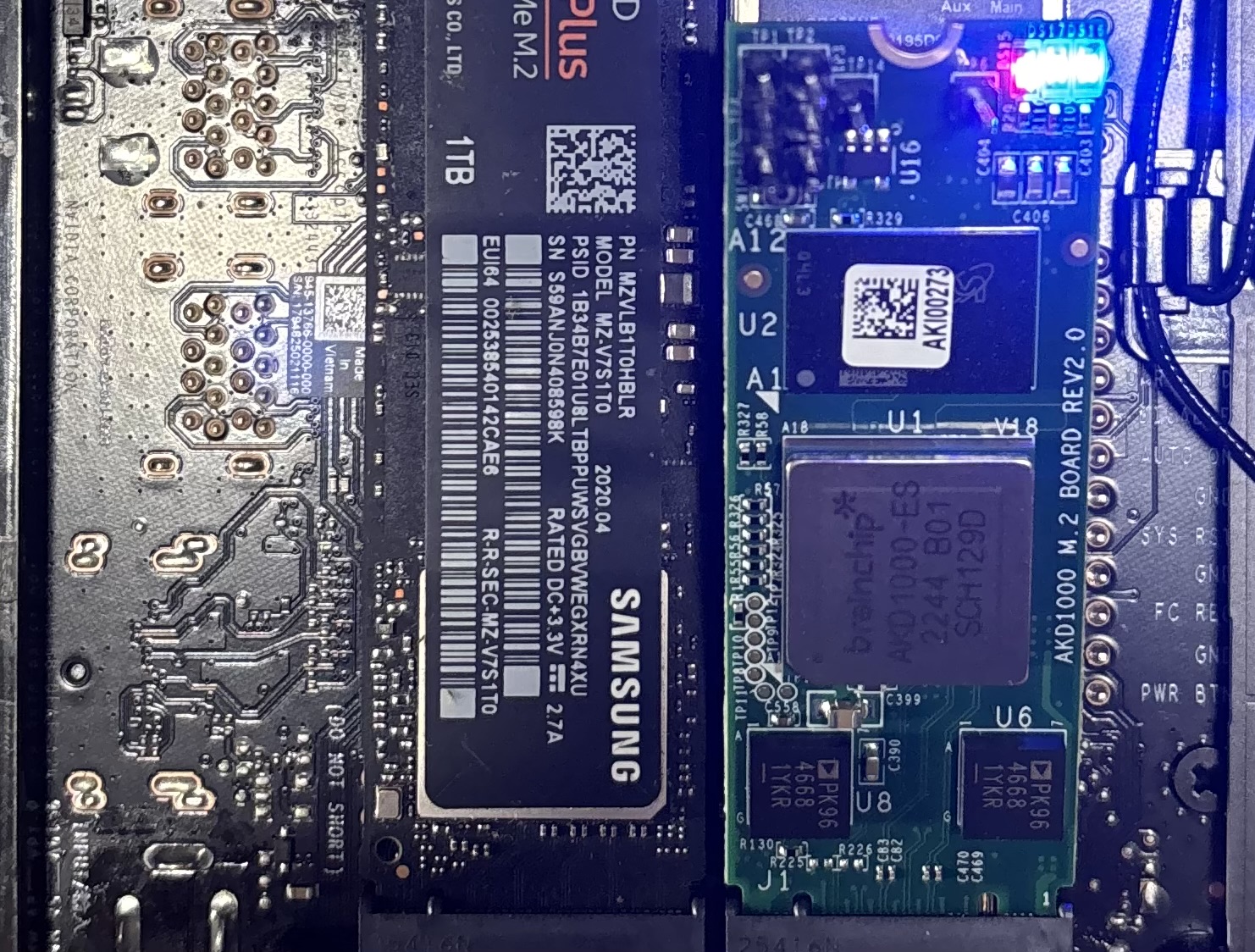
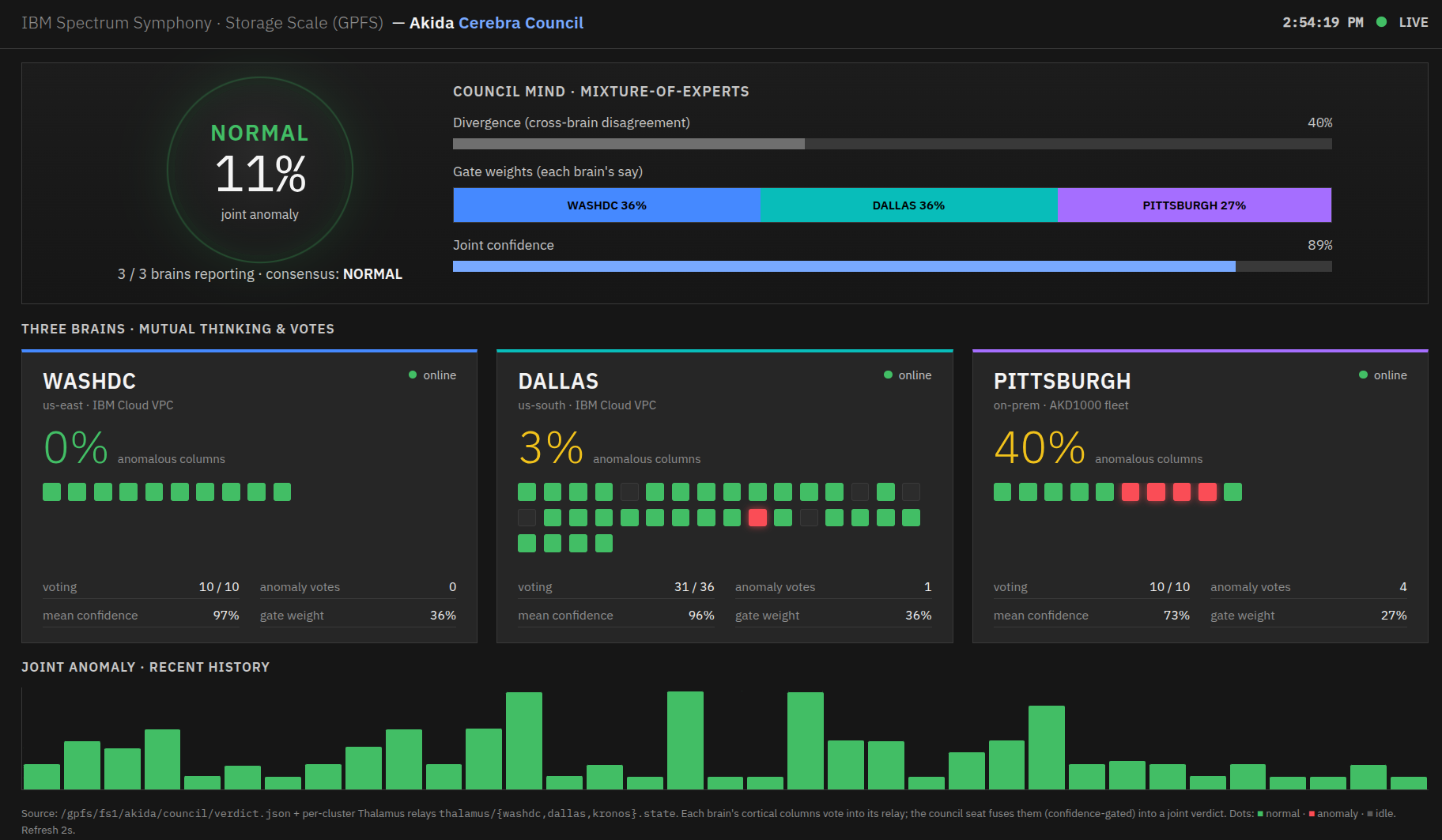
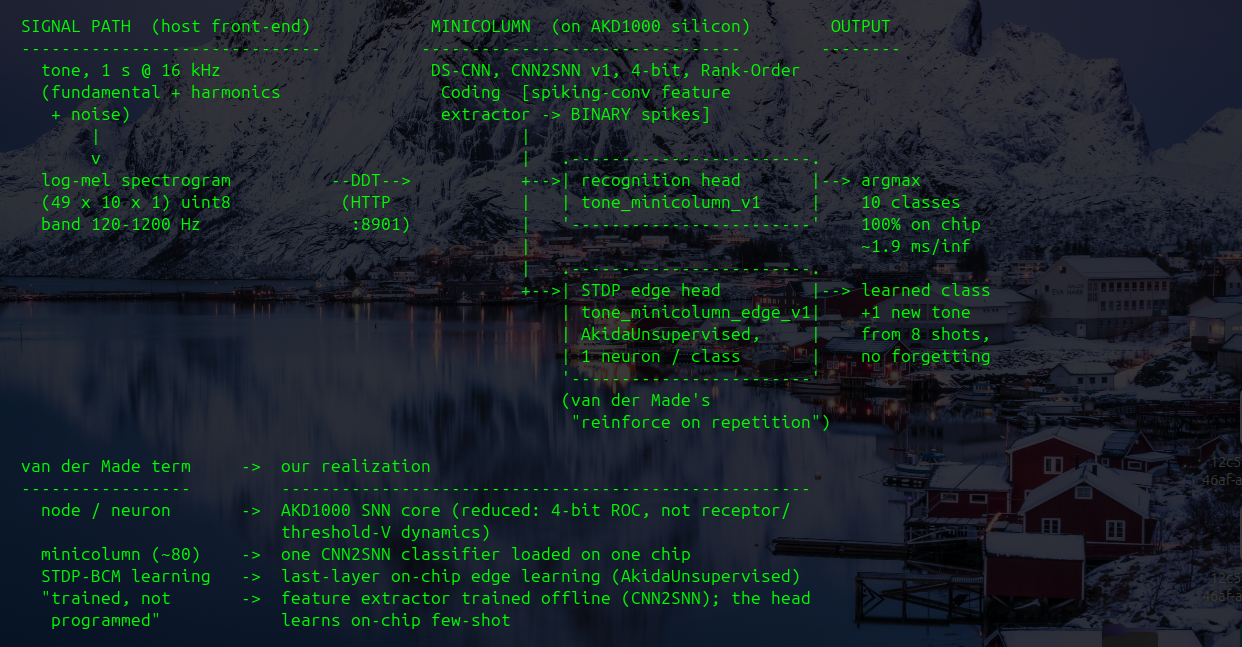
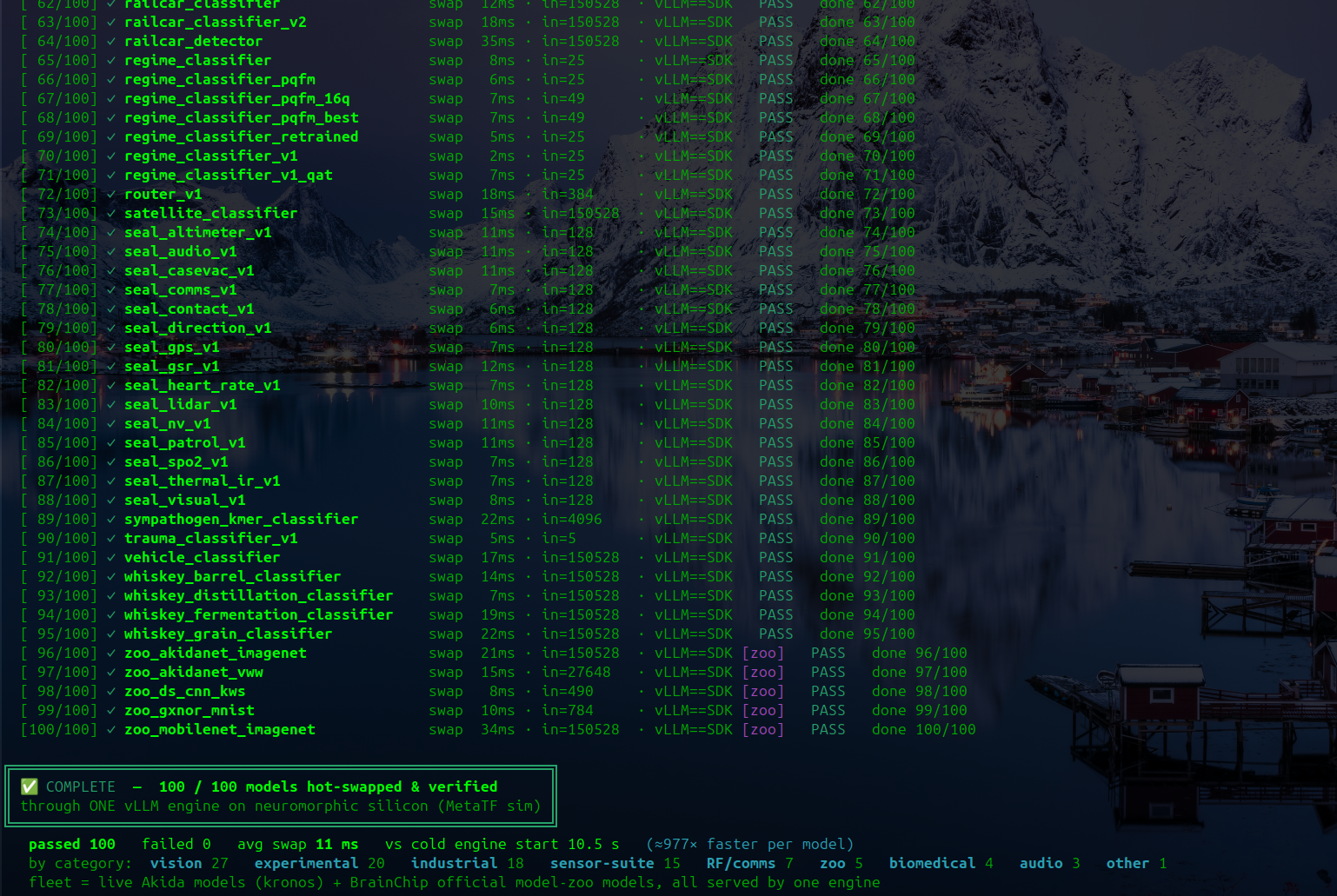
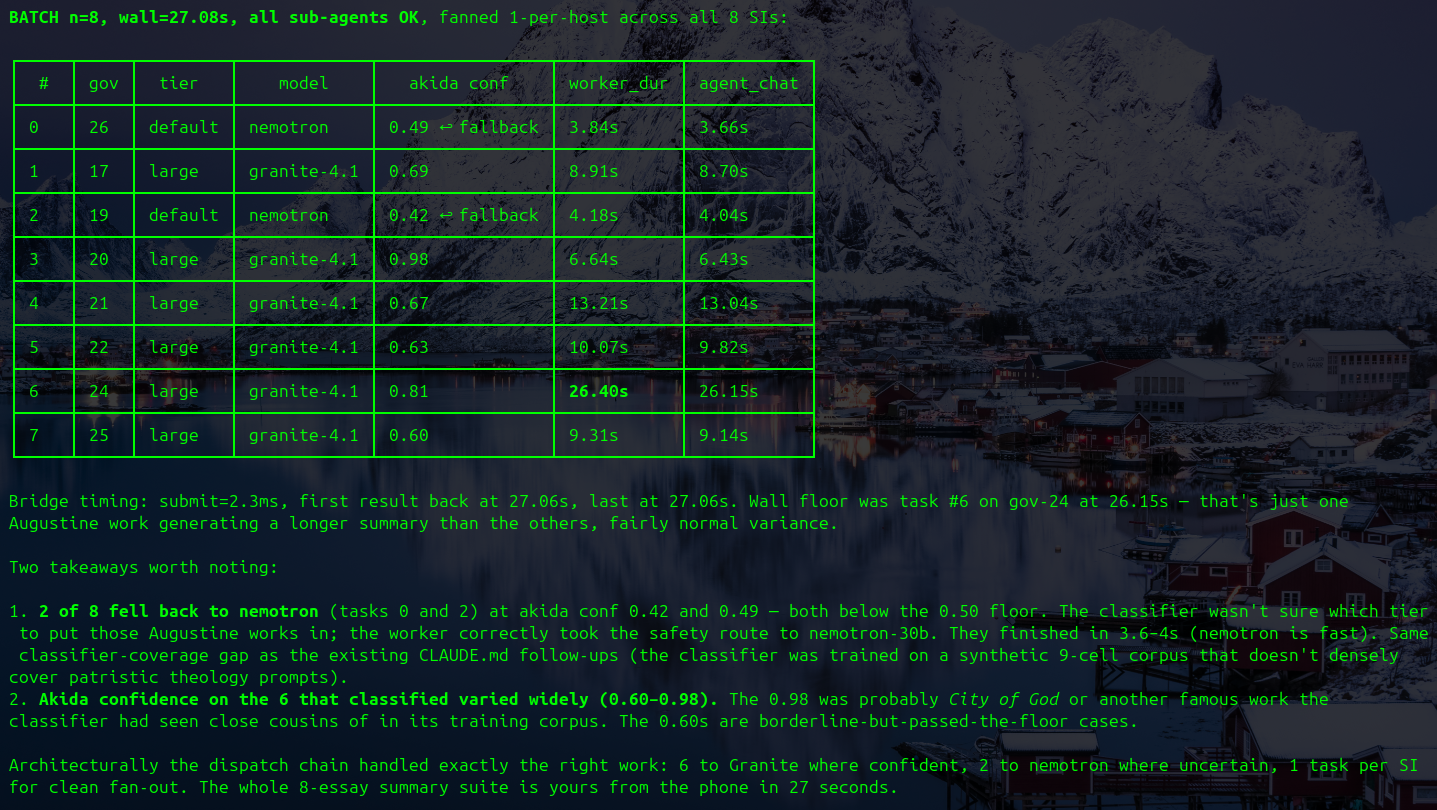
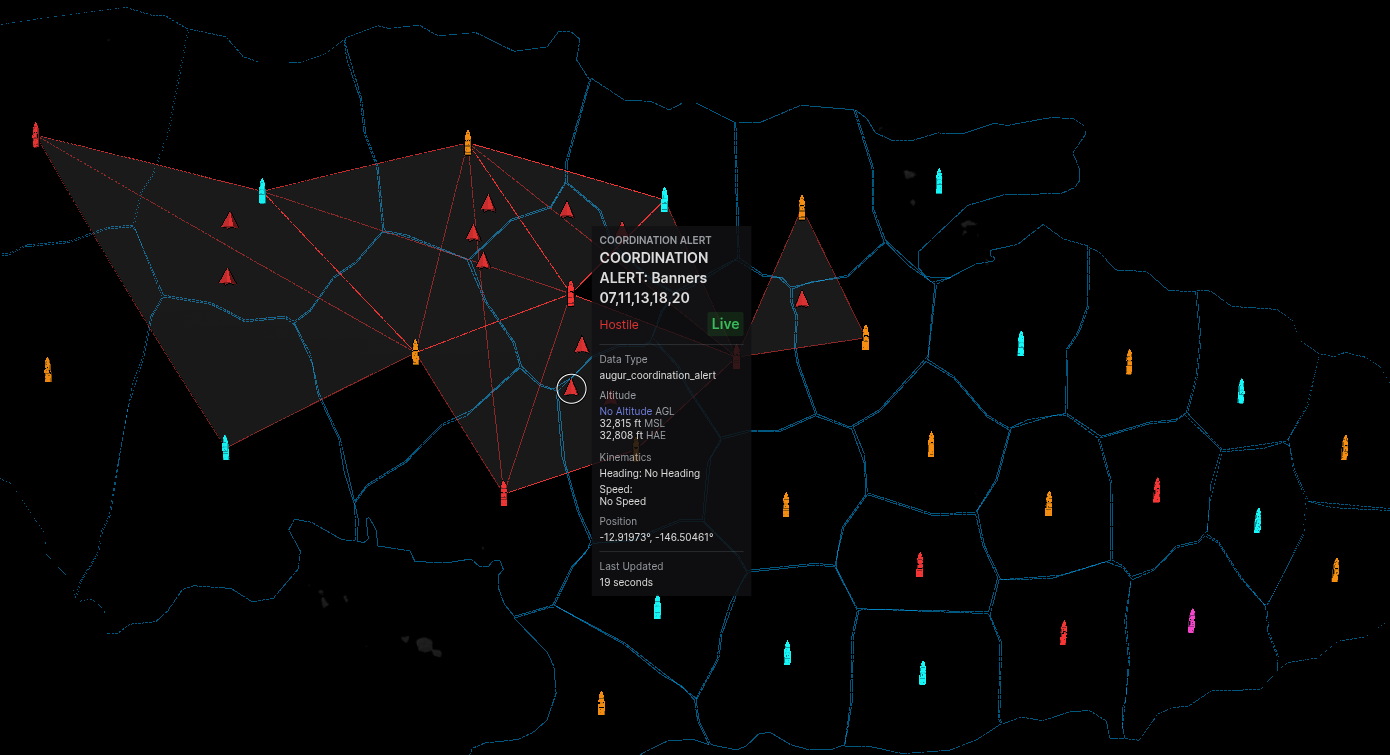
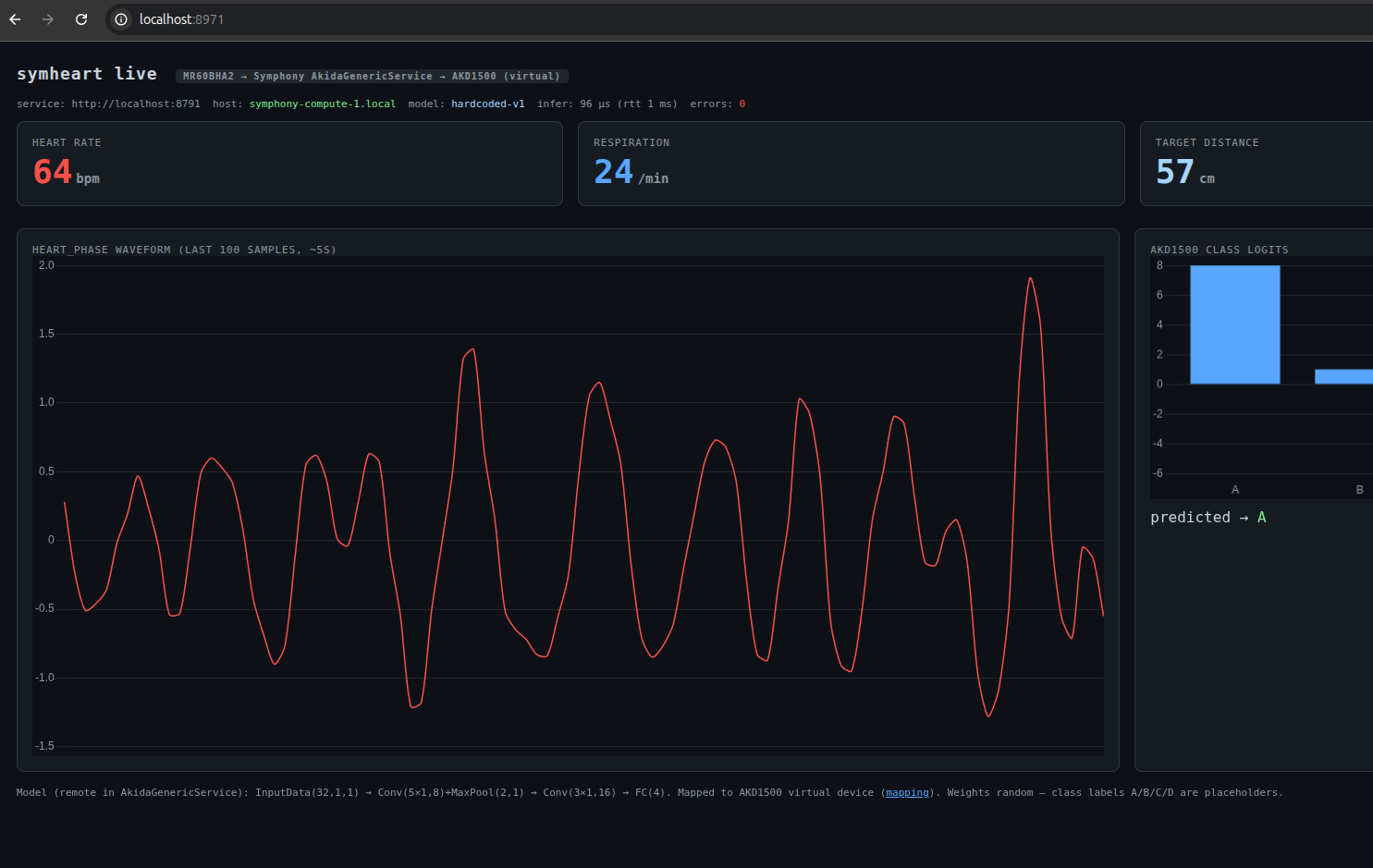
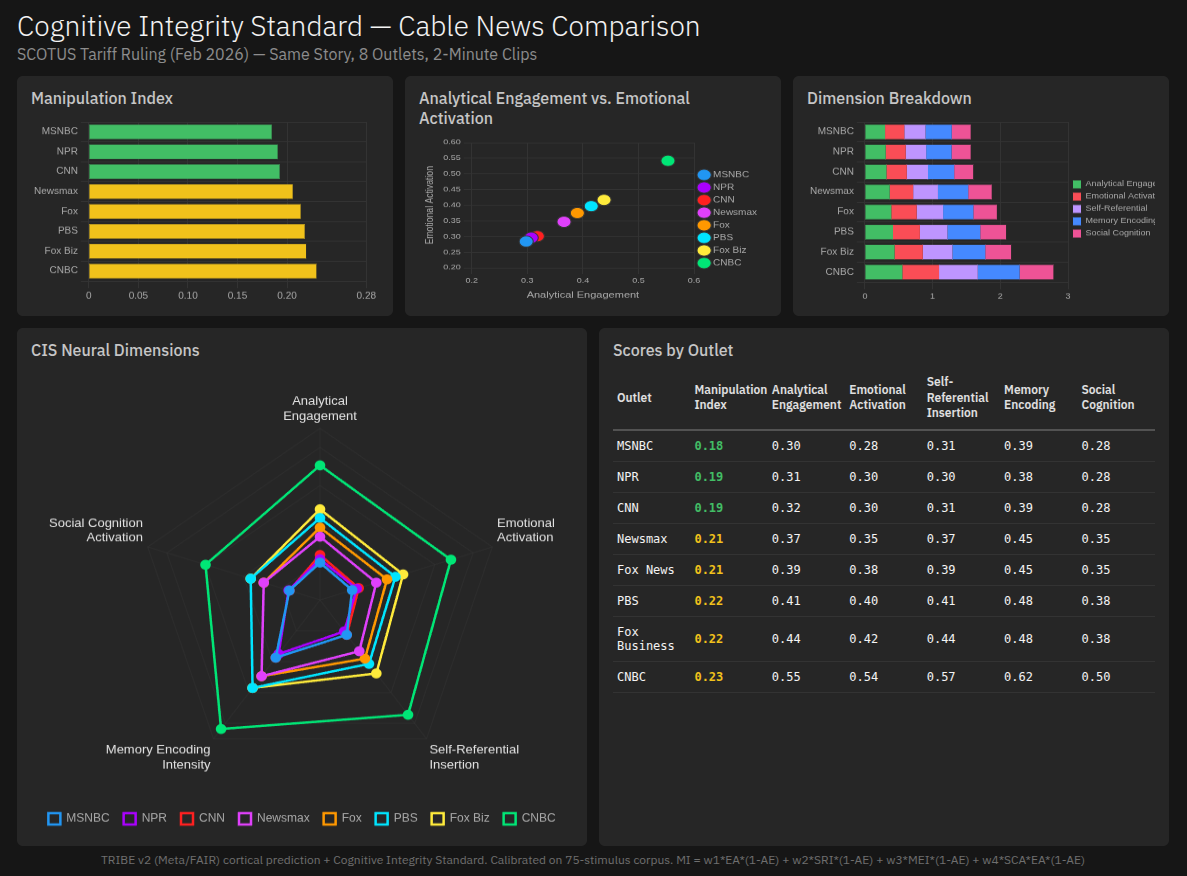
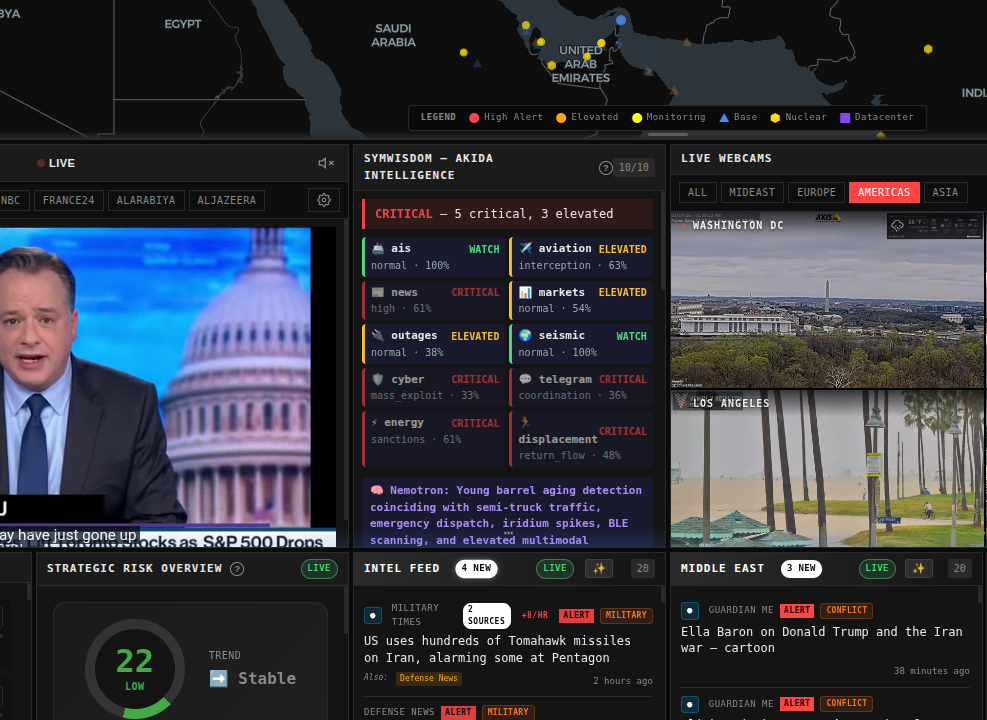
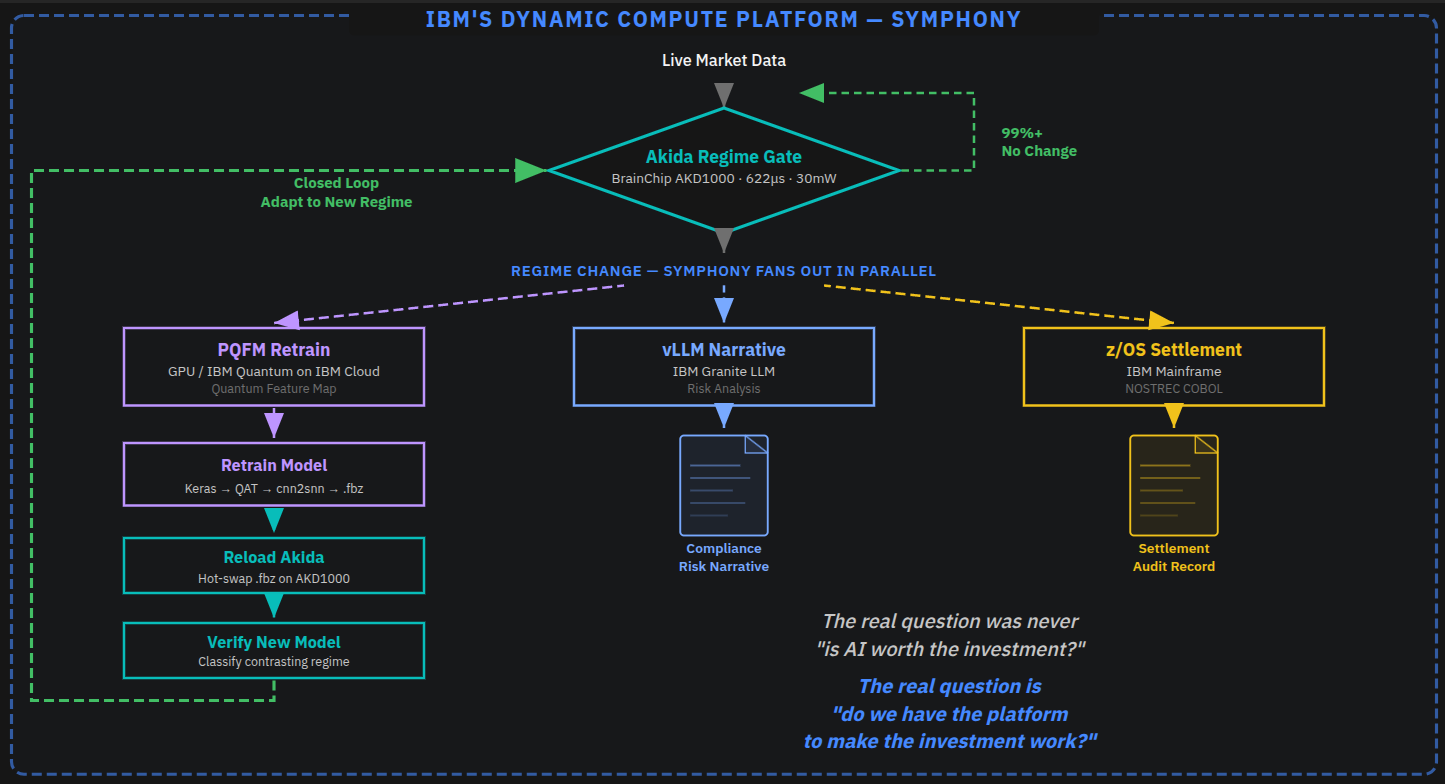
About
I work at the intersection of high-performance computing, AI infrastructure, and the data platforms that hold them together. Most of my career has been spent building and deploying these systems for organizations where downtime or bad answers aren’t an option. That includes financial services, government, defense, healthcare, and research.
I’m a Field CTO at IBM, focused on the HPC Cloud portfolio, which includes Spectrum Symphony, Storage Scale, and LSF. Before that, I spent over a decade in consulting engagements across the same stack. That work covered petabyte-scale parallel file systems, real-time workload orchestration, and the infrastructure underneath large-scale AI. Before IBM, I managed HPC biocomputing infrastructure at TGen, ran a specialty coffee company, and worked in storage virtualization and disaster recovery.
Lately, most of my independent work has been exploring what happens when neuromorphic hardware, large language models, and distributed orchestration frameworks are combined in ways their designers didn’t anticipate. The articles on this site come from that exploration.
I hold an MBA and a Master of Accounting in Finance from Keller Graduate School, an M.A. in Theology from Fuller Theological Seminary, and an M.S. in Global Technology and Development from Arizona State University, where I’m currently a Ph.D. candidate in Innovation in Global Development. My research examines how coordination infrastructure shapes what we can know, decide, and imagine, using computational AI and simulation methods to compare architectures at scale, arguing that infrastructure building is itself a mode of development theorizing.