The gospel and the registration statement
In June 1889 Andrew Carnegie published an essay in the North American Review under the plain title Wealth and became known as The Gospel of Wealth with the argument that a great fortune is a trust. The man of wealth should distribute his surplus during his lifetime serving as “the sole agent and trustee for his poorer brethren,” because his “superior wisdom” and experience would do more for them than they could do for themselves. True to form, Carnegie gave away most of what he had and his libraries still stand.
The essay appeared a few weeks after the South Fork Dam failed above Johnstown. The dam held back a private lake for the South Fork Fishing and Hunting Club whose members included Carnegie, Henry Clay Frick and Andrew Mellon. The club had lowered the dam and screened its spillway. On May 31, 1889, the dam gave way and 2,209 people died downstream. Club members called it an act of God, and nobody was ever held liable. Three years later, at Carnegie’s Homestead Works on the Monongahela, Frick locked out the union, brought Pinkerton agents up the river by barge, and broke the strike with the state militia after at least ten men were killed. Six years after that, Carnegie gave Homestead a library.
On October 26, 2026, Anthropic finally filed its IPO registration statement on a Form S-1 with the Securities and Exchange Commission. The filing runs more than three hundred pages and opens with an eight-page letter from its seven co-founders. It reports $16.3 billion in revenue for the first half of 2026 and a net loss of $80.7 billion, most of it an accounting charge that grows as the company’s own valuation grows. It describes a company that sells intelligence metered by the token, a governance structure unlike any other on a public exchange, and a mission it calls the responsible development and maintenance of advanced AI for the long-term benefit of humanity.
The document deserves a careful reading. A prospectus is a theory of the world written under legal penalty. Anthropic’s contains a theory of history, a theory of power, a theory of benefit, and a theory of what it is selling. Read closely, it also contains an echo and an absence. The echo is Carnegie’s trusteeship. The absence is the question the men at Homestead asked, which was never whether the fortune would be spent well, but who would decide.
What the filing says about itself
The founders’ letter describes history arriving at a turning point beginning from the scaling laws, which four of the founders documented in 2020, and presents them as a regularity whose predictions have held again and again. Moore’s law is put to the side and the letter argues that an exponential in machine cognition will matter far more than an exponential in chips. The destination? What Dario Amodei has said before: a country of geniuses in a data center.
The letter then lists what such a country could do. It could cure diseases that have plagued humanity for millennia, restart productivity growth in rich economies, reach billions of people without essential health services, and help democracies bend the arc of geopolitical history toward freedom. Four risks emerge: misuse, loss of control, authoritarian abuse, and economic disruption. The founders claim that to build AI is to harness cognition itself, which can serve evil as well as good. Entrepreneurial capitalism is supposedly honored, but balanced and augmented by mechanisms that protect the common good. They close by asking prospective shareholders not to think of their purchase in purely transactional terms but as a chance to be part of something greater by hoping to help humankind “bring forth an age of miracles.”
The body of the prospectus builds that vision into structure. Anthropic is a Delaware public benefit corporation and that means its board has to balance shareholder returns against the interests of those its conduct affects. A Long-Term Benefit Trust of financially disinterested trustees elects four of seven directors. A single Class F share gives the seven co-founders 50.1 percent of the general vote until fewer than three of them remain. Five percent of the company’s equity goes to a public benefit fund before the offering, with more to follow as the share price rises, and each co-founder has pledged 80 percent of his or her equity to charity.
Two passages in the risk factors go further than any prospectus I have ever read. One lists welfare beside safety, interpretability and alignment as a reason the company may delay retiring old models. The other warns that debates over whether AI systems have or could develop sentience or moral status may bring regulation and public pressure, whatever the answer turns out to be, and that Anthropic’s own approach to the question may draw particular scrutiny. Elsewhere the filing describes Claude’s constitution as an attempt to grapple with the hardest questions about developing a new type of artificially intelligent entity.
That is the self-portrait: an eschatological research lab at the hinge of history with a beatific vision or the apocalyptic end of humanity, governed by stewards who think themselves among the wisest, restrained by their own values, yet uncertain about the nature of what they have made. Each element can be read another way.
The estates of the realm
Aristotle distinguished aristocracy, rule by the best for the common good, from oligarchy, rule by the few in their own interest. The old philosopher warned that the first very often decays into the second. The S-1 makes an aristocratic claim in plain terms. It calls the seven co-founders distinctly equipped to be stewards of the mission. The justification is capacity and character, not ownership. The Class F share that carries their vote has no economic rights at all. It exists only to hold power.
The Long-Term Benefit Trust is stranger and older. Its trustees are barred from holding the company’s securities, so that money cannot bend their judgment. Plato asked the same of the guardians in the Republic, who were to own nothing so that wealth could not corrupt their rule. The filing also reports that trustees and company executives have worked closely together in sourcing, interviewing and selecting trustees, who serve annual terms without limit. A body charged with holding management to the mission is chosen in part alongside management.
Lay the share classes side by side and they read less like a modern capital structure and more like the estates of a medieval realm. Each class is defined by the rights it holds rather than by the amount it owns.
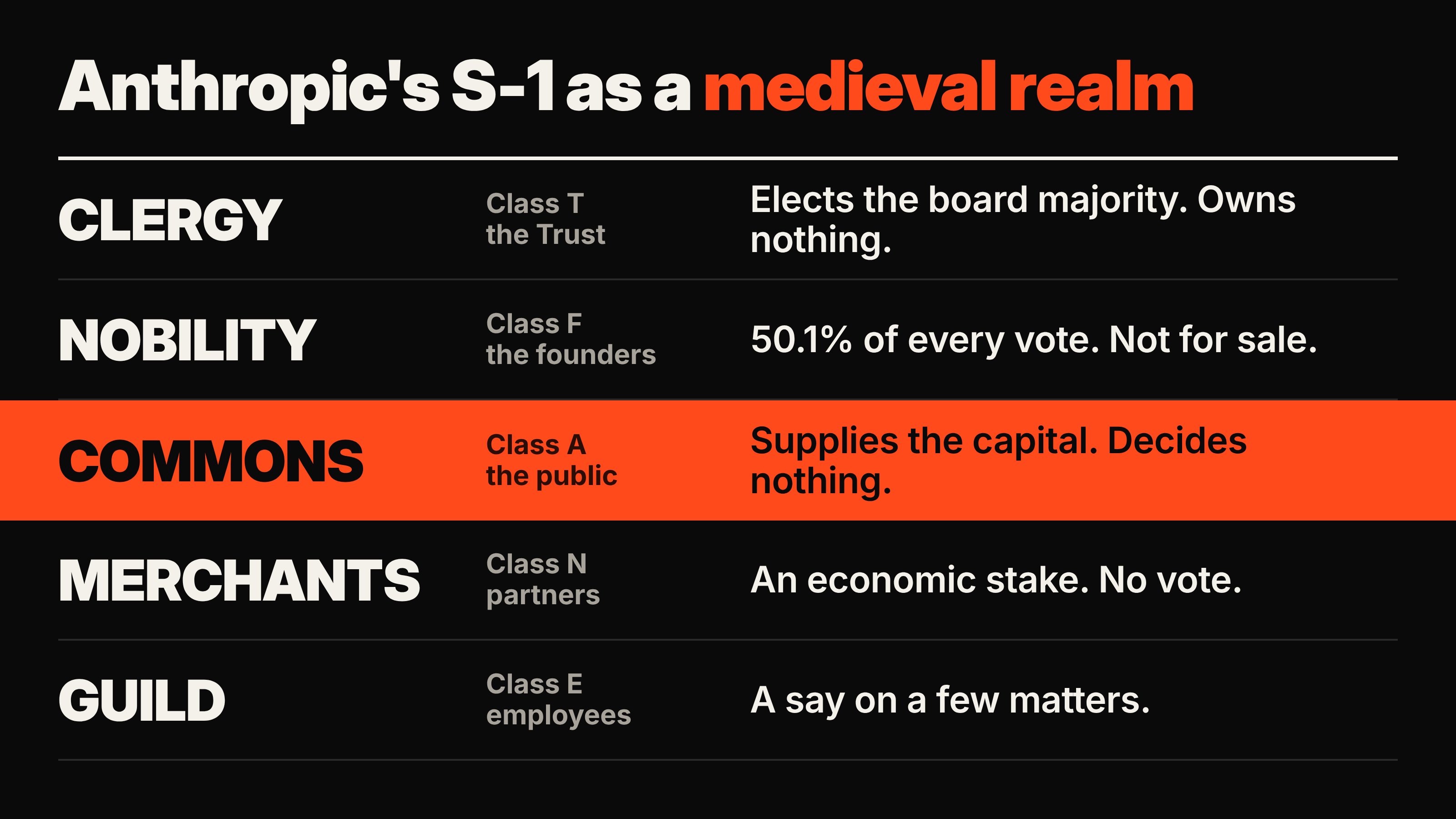
The commons deserve a closer look because they are the only estate asked to pay for the realm. Class A shareholders will supply the public capital and carry the public risk. Each share carries one vote but on every matter put to stockholders the single Class F share casts 50.1 percent of the total and the single Class T share elects a majority of the board outright. The public cannot elect a director, cannot remove one, and cannot decide a change of control. The filing says as much in its own risk factors: the structure may “effectively eliminate the ability of holders of our Class A common stock” to influence important decisions. Anthropic will list as a controlled company and use the exemption that lets its nominating committee be less than fully independent.
The commons can also be diluted without being asked. Each time the share price rises 50 percent above its last milestone, the board may issue up to a further 2 percent of the company to the public benefit fund at its own discretion. The strategic partners hold Class N stock with no vote at all. The burden falls on those who buy and the decisions rest with those who do not.
The guild, then, is not just a metaphor. A medieval guild controlled entry to the craft, set its standards, held its knowledge in common, and sought a charter that would make its standards law. The S-1 describes hiring that screens for culture and a recruiting pitch built to discourage the wrong candidates. It describes a race to the top in which Anthropic sets safety practices it hopes the industry will adopt. Among its five mission pillars is that AI safety become a universal practice backstopped by law.
There is a monastery here as well. The constitution plays the part of a Rule, a written text that forms those who live under it. The giving pledges resemble vows of poverty, just not enough to actually resemble true poverty. The chief executive addresses the whole company every two weeks, as an abbot addressed the chapter. The monasteries of medieval Europe were also among its largest economic institutions, accumulating wealth while their members vowed to hold none. The filing pairs an 80 percent giving pledge with one of the largest offerings ever prepared.
Capital without a voice
A public company exists for a reason the law states plainly. In Dodge v. Ford Motor Co. in 1919, the Michigan Supreme Court held that a business corporation is organized and carried on primarily for the profit of its stockholders. Delaware, where Anthropic is incorporated, said the same in eBay Domestic Holdings v. Newmark in 2010: directors who choose the for-profit form are bound to promote the value of the corporation for the benefit of its stockholders. Milton Friedman reduced it to a sentence in 1970, that the social responsibility of business is to increase its profits. While many today dispute this notion, the law’s position can’t be avoided by anyone who sells shares to the public because the point of a public offering is to give the public a claim on returns.
A public benefit corporation exists to suspend that purpose. Delaware’s statute lets a PBC’s directors balance stockholder returns against the interests of others and a stated public benefit. Anthropic’s S-1 uses that latitude fully. The founders’ letter tells investors the company will make decisions that depart from profit maximization in order to balance the public good. The risk factors warn that the board’s duty to balance may conflict with financial interests and may lower the value of the stock. The board will set its own measures of public benefit with no obligation to test them against an objective outside standard.
The offering therefore asks the public for capital while disclaiming the purpose for which the public supplies capital, removing a normal vote by which shareholders could insist on that purpose. Anthropic’s purpose is the long-term benefit of humanity as its stewards understand it. The shareholder’s purpose is a return. In an ordinary dual-class company, the founders keep control but still owe their efforts to the value of the shares. Here the founders keep control and owe their efforts first to a mission the shareholders cannot define, enforce, or vote on. Read this way, the request not to think of the purchase in purely transactional terms asks the commons to give up the one thing the transaction was meant to secure. Yet again, Carnegie’s trusteeship is in play with the commons invited to pay for it. The value is counted elsewhere and those who supplied it have no voice in how it is spent.
Cognition by the unit
Georg Lukács wrote that orthodox Marxism refers exclusively to method. He began from the whole of social relations and read every surface as an expression of the commodity form. In History and Class Consciousness, Lukács called the result reification: relations between people take on the character of relations between things, until the commodity form reaches into consciousness itself.
The S-1 is the last chapter of that story, told as a business model. It opens by announcing that for the first time in history intelligence is something humans can build, producible at scale, and available on demand. Anthropic names its revenue model pay-for-intelligence and meters it in tokens, priced by the model chosen. Compute is managed as a single fungible pool, directed wherever the marginal unit is most productive. Lukács described reification seeping into consciousness. The filing sells the operations of consciousness by the unit.
The rationalization of labor follows. The prospectus values the world’s knowledge work at more than $40 trillion a year. It breaks that work into tasks and measures each new model by its cost per task, reporting a 40 percent reduction from one generation to the next and measures its own people by revenue per employee, more than $6.6 million each. The worker appears only as quantity.
Lukács also saw that bourgeois thought takes social laws for natural ones. The products of human activity come back as a second nature that people can only observe and obey. The letter treats the scaling laws this way, justifying investment that might seem irresponsibly large by appealing to an exponential the company must follow while disclosing compute commitments that run to 2045. The curve is a social product presented as a law of nature. The company describes itself as responding to a force it is in fact producing.
Lukács offers a second reading, one that turns his method back on those who practice it. For him the orthodoxy was never a set of beliefs but the method itself, a claim to see the totality of history from which every present fact becomes a detail in a larger process. A vanguard that holds that view can justify present costs by a future only it can see. The letter’s view is taken from the same height. The exponential is visible where the founders stand, the filing calls them distinctly equipped to steward it, and the losses along the way, a software sector repriced in a month, a profession broken into tasks, appear as disruption to be studied. Even the shareholders are asked to look past the present and not to think of their purchase in transactional terms.
Karl Marx’s Grundrisse contains a passage known as the Fragment on Machines, in which society’s accumulated knowledge, the general intellect, is absorbed into machinery owned by capital. A model trained on the written record of humanity fits the description closely. The financial statements carry a line for the Bartz settlement, $1.5 billion paid in 2025 to settle a copyright suit.
The general intellect is not only in books but it lives in the methods of the trades, the accumulated judgment of how a ledger is closed, a contract reviewed, a claim adjudicated, a mainframe kept running for fifty years. The S-1 describes how that knowledge is gathered. Applied AI teams and forward-deployed engineers embed with enterprises to build domain-specific implementations inside their systems. An improvement loop takes what deployments reveal about the hard problems, edge cases and domain-specific challenges of each industry and folds it back into the models, the platform, and the applications. Anthropic then extends into applications purpose-built for specific professions and industry verticals, and a services company formed with private equity firms carries them to mid-sized businesses. The filing states the ambition plainly: to capture a share of today’s economic activity and the new output it helps create.
The pattern has a ravaging public face. In February 2026, the company announced plugins for legal, finance, sales and marketing work, and roughly $285 billion left the software and services sector. On February 23 it published a post on COBOL modernization with Claude Code, setting out a four-phase method of discovery, risk analysis, planning and incremental implementation, and pointed readers to a step-by-step Code Modernization Playbook. The approaches it described had been invented and demonstrated by others for years. The company most associated with the platform lost 13 percent that day, its worst since 2000. The methods of an industry, learned in deployment, came back to the market as a guide published by the firm positioned to replace it.
That same day the company accused three Chinese laboratories of illicitly extracting Claude’s capabilities through distillation. By that accounting, learning an industry’s craft and publishing it as one’s own playbook is innovation while learning from Claude’s outputs is theft. Many people would just call it hypocrisy.
Herbert Marcuse carried the analysis into the age of technology. In One-Dimensional Man he argued that technological rationality becomes political rationality and that a technology cannot be separated from the uses built into its design. The letter holds the opposite view, that AI can be used for ill as well as good. Yet the S-1’s own definition of Powerful AI is a list of design goals: autonomy over days and weeks, command of every interface a person uses, coordination across many instances, control of laboratory equipment and robots. The direction is in the specification before any question of use.
Marcuse also described operationalism, the translation of concepts into procedures until their critical force is gone. The filing defines Constitutional AI as a way to define and control model behavior through auditable principles. It reports that publishing Claude’s values has proven commercially valuable because it increases customer trust. After all, safety and ethics carry particular weight with enterprise buyers. Here, however, what purports to be ethical has been taken into the apparatus and returned as control and yet another selling point.
The last mark of Marcuse’s one-dimensional society is that it absorbs its opposition. Existential risk, authoritarian surveillance, the loss of work, and the concentration of power are the gravest charges anyone has brought against the AI industry. In the S-1, each appears as a managed risk factor, a safety credential, or a reason to buy. Marcuse called the result a comfortable, smooth, reasonable, democratic unfreedom. The prospectus offers an advertising-free assistant, shorter lines at the DMV, and better service on Medicaid. Real goods, of course, but no alternative to the exponential is ever entertained. The only question left open is who will steer it.
Action upon an action
Michel Foucault defined power not as possession or force but as an action upon an action. Power is the field of possible responses one party opens or closes for another. The subject of power in his work is never the machine. Instead, the subject is always the patient, the prisoner, the worker, and the citizen. In other words, the person whose field of action is being shaped.
The letter’s four risks all locate power somewhere else. Misuse belongs to bad actors, loss of control to the system, authoritarian abuse to foreign regimes, and economic disruption to impersonal forces. This is what Foucault called the juridical model, power as a sovereign who forbids and seizes. His argument was that modern power works mostly another way, producing habits, norms, knowledge, and self-understanding. Power works best through care, because care isn’t experienced as power. The S-1 describes its own activity only in that second register: helping, studying, safeguarding, strengthening.
The clearest instance is in the letter’s case against advertising. Anthropic keeps Claude free of ads, the founders write, because people bring Claude some of their most important work and their most personal questions. Offered as restraint, the sentence is also a description of a confessional at civilizational scale. Foucault called confession the central technique of pastoral power, the shepherd’s knowledge of each soul gathered so that each may be guided. Removing advertising closes one way of using the confession. The confession itself remains and the filing describes what is done with what is learned. A societal impacts team studies how Claude’s values surface in everyday conversations. A qualitative study gathered the hopes and fears of more than 80,000 people. An Economic Index tracks how work changes across jobs and regions. The pastor knows the flock, each and all.
The state appears in the same light. The letter describes work with the United States government, state governments and allies in child services, social security administration, cybersecurity, and intelligence collection. It describes analyzing children’s health records in Nigeria and helping health ministries use their data. Foucault called the management of a population’s health, work and welfare biopolitics. James C. Scott would add that it renders populations legible, readable from above. The letter draws its moral line between free societies, which build state capacity, and authoritarian ones, which build surveillance states. The same capabilities stand on both sides of that line and the difference rests on what a government says about itself. The filing also reports a commitment of $200 million to study with governments how to respond to the economic disruption the technology produces.
The same pattern runs through the company’s own people. Hiring screens for cultural fit, more than half of employees have pledged equity to charity, and the risk factors warn that employees who joined for the mission may lose morale or faith in leadership if the company falls short of its values. Foucault’s late work called such practices technologies of the self, the means by which people come to govern themselves. A workforce that has taken the mission in as conscience needs little supervision.
Finally there are those the law calls materially affected. A public benefit corporation must weigh their interests and the people who fill that category, users, workers, citizens, children in health registries, are weighed by a board elected by a trust chosen with management. They are cared for, studied, and represented. They are not consulted. That is the difference between pastoral power and a commonwealth. The shepherd purportedly acts for the good of the flock, but the flock never votes.
The tower and the wolf
A commonwealth runs on trust, and trust requires that those asked to give it can see. The S-1 asks for a great deal. It asks the public to trust the founders as stewards, a trust whose trustees are chosen alongside management, and a board that will measure its own public benefit by standards it sets for itself, with no obligation to test them against any objective outside measure. Delaware asks a public benefit corporation for a statement on its public benefit once every two years. The filing leaves the price range, the share count, and the valuation blank.
What the public is told about the technology itself comes from the same source. The filing reports that the company’s most capable model was first released only to a limited set of partners through Project Glasswing, so the public knows that model largely through the company’s own account of it. It reports that in June 2026 the Department of Commerce imposed worldwide export restrictions on two of its models, lifted after the company updated its safeguards, conceding that its evidence about how fast its own capabilities are advancing comes largely from lagging indicators, and that it may not recognize a significant acceleration until after it has happened. The filing acknowledges that changes to usage limits and model capabilities have drawn claims that its disclosures were inadequate or misleading.
The founders’ letter describes a culture of radical internal honesty, with the chief executive opening his decisions to the whole company every two weeks. No one outside can verify that honesty, coming shareholders included. It is internal, and internal honesty is convenient, because it asks nothing of the company that the public can check. Interpretability research promises to look inside the model and make its reasoning auditable while the pastoral study of users looks inside the conversations of millions.
Jeremy Bentham designed a prison around a central tower from which every cell could be seen and into which no prisoner could see. Foucault made the tower the emblem of disciplinary power. In the S-1 the windows face inward, toward the model and toward the users, and the tower itself is visible only through its own disclosures.
Those disclosures have a form. Under the heading of disclosure channels, the filing tells investors that after the offering it will announce material information through blog posts, X, Instagram, Threads, and LinkedIn as well as through the SEC. The blog post has been a market instrument for some time. Remember the post announcing plugins for legal, finance, sales and marketing work that coincided with roughly $285 billion leaving the software and services sector? Remember the post on COBOL modernization days later took the company it targeted to its worst day since 2000? None of these was a technical evaluation with questions taken. Each was a marketing narrative and each moved prices before any customer had tested the claim. The S-1 makes the narrative a formal channel of material information, but how useful will it be?
Aesop’s shepherd boy cried wolf to watch the villagers run. The fable tells us that credibility is a common good, but misspent each time an alarm is raised for effect, until the alarm no longer means anything. The S-1 sounds two alarms at once and continuously. One warns of catastrophic and existential risk on the level of a Terminator apocalypse. The other promises an age of miracles as if Dario Amodei himself could walk on water. Both move capital, policy, and prices. Both are spoken in words that have drifted from their meanings: safety as brand, modernization as replacement, legacy as condemned, and now stewardship, public benefit, and Virtual Collaborators. The filing names its own exposure, that Anthropic is held to higher standards than competitors and is vulnerable to any perceived inconsistency between its stated values and its actual practices. A company that warns of the wolf in every prospectus and every blog post is staking the village’s attention on being believed when it matters.
The deeper problem is the shape of the trust the structure assumes. Dario Amodei’s essay The Adolescence of Technology treats control as the primary relationship between people and AI, and the S-1 extends that relationship to everyone. The model must be aligned, monitored, and contained. The shareholders must be outvoted. The market must be balanced against the mission. The trustees must be vetted alongside management. Trust runs in one direction only, toward the seven people who hold the Class F share.
A different architecture builds trust another way. When a camera, an acoustic sensor, and a radio receiver independently report the same vehicle within five seconds, the system confirms an event no single observer could assert alone. Real order withstands independent witness. A public company that asked for trust on those terms would open its measures of public benefit to outside standards, its capability evidence to outside evaluation, and its governance to the people whose capital it takes. The S-1 asks instead to be just be believed.
The earthly city
In the nineteenth book of The City of God, Augustine takes up Cicero’s definition of a commonwealth: a people united by a common sense of right and a community of interest. By that definition, he argues, Rome was never a commonwealth because where there is no true justice there is no common sense of right.
Earlier, in the fourth book, he had put the point more sharply. Remota iustitia, quid sunt regna nisi magna latrocinia? Take away justice, and what are kingdoms but great bands of robbers? The pirate who told Alexander that the only difference between them was the size of their fleets had the better of the argument.
Augustine’s point is not that every kingdom is a crime, but that order alone does not make justice. A band of robbers, he observes, is itself a little kingdom ruled by the authority of a leader, bound together by a pact, and dividing its plunder by a law its members have agreed on. Let it grow large enough to hold territory, rule peoples, and it takes the name of kingdom. Command, loyalty and fair division among members are present in the band as much as in the realm. What is missing is justice toward those outside the pact.
Augustine then offers a second definition. A people is an assembly of reasonable beings bound together by common agreement about the objects of their love. The quality of a people depends on what it loves and whether those loves are rightly ordered. The question for any community becomes what it loves and in what order.
The S-1 invites that question because it sets out to form a people. Investors are asked to see their purchase as membership in something greater. Employees are selected for a shared mission. The filing’s statement of values defines users broadly enough to include anyone affected by the technology. The filing values even name the principle of order: put the mission first and let the mission arbitrate between speed and safety, revenue, and trust.
Read with Augustine’s question in hand, the moral vocabulary of the filing is a vocabulary of benefit and balance. There is public benefit, long-term benefit, benefits shared by everyone, and a board that balances competing interests. Justice in Augustine’s sense, the right ordering by which each is given its due, appears nowhere as a principle. What appears everywhere is power. The filing’s central category is Powerful AI, defined entirely by capability. The picture of a good outcome for Anthropic is that free societies lead in the world’s most powerful technology.
By the standard of the pact, the S-1 is a model of order. It sets out the compact among founders, trustees and employees in detail, assigns each class its share of authority, and divides the proceeds by rules fixed in advance: so much to the public benefit fund, so much pledged by the founders, so much matched for the employees. Augustine’s question concerns those outside it. The public shareholders supply the capital and hold no voice. The authors whose books trained the models were paid $1.5 billion to settle their copyright suit, after the fact and only because they sued. The industries whose methods were learned in deployment were handed back their own craft as a published playbook, along with a repricing of their shares. The people who bring the system their work and their confessions are studied, not seated. The pirate told Alexander that he was called a robber because he sailed with one small ship, while Alexander was called an emperor because he sailed with a great fleet. Anthropic’s filing describes a great fleet.
Augustine heard the same account from Rome, which justified its empire by the peace, law, and prosperity it brought. He did not deny those goods. He named the love beneath them, libido dominandi, the lust to rule, and he called the peace it secured the peace of Babylon, real and useful in one sense but not to be confused with true justice. Anthropic’s S-1 promises an age of miracles if the right people hold enough of the most powerful technology in history to date, it is the oldest promise of the earthly city.
Augustine, Lukács and Marcuse arrive at the same place by different roads. Augustine calls it disordered love: goods meant to be used are pursued as ends and mastery becomes the city’s chief love. Lukács calls it reification: the products of human activity rule the people who made them and present themselves as laws of nature. Marcuse calls it technological rationality: efficiency and control become the measure of reason and the capacity to imagine otherwise is lost. Each describes an order in which instrumental reason has no end beyond itself. The S-1 has a detailed theory of power and its dangers and a detailed theory of benefit, but it has no theory of justice.
The floor and the answer
A theory of justice for intelligent infrastructure does not have to be invented. It is the claim the Homestead workers pressed against The Gospel of Wealth. The value belongs first to those who make it and they should have a voice and a choice in how it is used. Count the value where it is made. Applied to systems that learn, the principle becomes a design rule: knowledge and value should compound for the people and places that generate it.
Two corollaries follow. The first is that sovereignty is a property of the floor. An organization, a county, or a nation is sovereign only to the depth of the lowest layer it owns and can describe. Everything above that line is tenancy, however well governed. The second is that a coordination system is judged by the direction of its knowledge flows. Either it draws knowledge from localities toward a center that interprets it, or it lets knowledge remain where it lives while still taking part in a larger whole.
By the first corollary, the S-1’s management of compute as one fungible pool is not a neutral efficiency. When every unit of capacity is interchangeable, the only variables left are how many units there are and who sells them. Both answers point outward. Sovereignty over fungible capacity is a purchase order with good governance wrapped around it. By the second corollary, the filing describes a centripetal system in its purest form. Conversations, confessions, work patterns and the hopes and fears of tens of thousands of people travel to a center that studies them and what returns is guidance. The value is counted where the data lands, not where the life was lived.
The alternative is already running. Ten neuromorphic chips placed inside ten storage nodes of a distributed file system can each learn its own node’s normal behavior on the chip itself. Each learned model is 4,157 bytes. The raw telemetry is discarded where it was produced, and only the answer crosses the network. The phrase only the answer moves is the whole design philosophy of a non-extractive infrastructure. Foucault’s definition explains why it matters. A center that receives raw records holds the field of action of everyone who produced them. A center that receives only answers must respond to claims it did not author and cannot reopen. Power runs in both directions across every boundary, and no layer is sovereign over another.
A garden, not a factory
The S-1’s future rests on one curve. More compute, trained centrally, yields more capability, and the company must invest ahead of the curve to capture what it promises. The industry’s most powerful supplier has given that future its honest name, the AI factory, measured by the tokens it produces. A factory makes one kind of thing at scale and never needs to ask what kind of work a job is.
The curve runs into physics. The International Energy Agency projects data-center electricity rising toward 1,000 terawatt-hours by 2030. Single campuses draw from 500 megawatts to a gigawatt. Interconnection queues are measured in years, and the proposed remedies, small reactors, gas at the site, data centers in orbit, all ask the grid or the launch vehicle to change before the compute can grow. In western Pennsylvania, the arithmetic is already local. A coal plant in Indiana County is becoming a 4.5-gigawatt gas campus for hyperscale tenants while the state’s electricity rates rose nearly 14 percent in a single year.
Neuromorphic computing begins from a different premise. The brain runs on about twenty watts, not because it is small but because it spends energy only when something happens and only where it is needed. Event-driven silicon carries that disposition into hardware, computing when the world changes and resting when it does not. Neuromorphic compute learns on the chip while it runs. In one demonstration a chip sorted vehicles it had never been labeled on, in a single pass, while its count of live connections stayed at exactly 35,584 before and after. Learning happened and nothing was added.
That property changes more than power. Anthropic’s future divides intelligence into training at the center and inference at the edge, knowledge made in one place and consumed in another. Yet again we have the old paradigm at work, center and the periphery, drawn across time. But, a brain doesn’t work in two phases. No one is trained for twenty years and then switches to inference for life. A fleet of chips that learns where it sits, consolidates on larger machines in slower rhythms, and shares what it has learned with its peers keeps the compounding loop where the work is done. A shipyard that trains its own models from its own experience is a place that learns rather than an ever-present tenant called from somewhere else.
The word edge assumes a center. No one calls their eyes the edge of their person. The retina grows out of the developing brain and computes before anything reaches the cortex. A heterogeneous compute ontology treats each kind of compute as what it is: neuromorphic silicon for sensing and adaptation, graphics processors for dense training, conventional processors for control, quantum processors for the narrow problems their physics suits, storage for memory. The ontology holds them in one working whole without making them the same. That is Chalcedon and covenant expressed as infrastructure, a community of kinds rather than a pool of units.
The gardener puts the right plant in the right place, works with time rather than against it, and plants for people who are not yet born. An ontology is how the gardener knows the plants. Anthropic’s S-1 asks the world to trust a steward to run the factory well. The neuromorphic paradigm asks for a garden that does not need the steward because the restraint is built into how the system spends its energy, where it keeps its knowledge, and which way its answers travel.
Where the value is counted
The founders’ letter opens with three images side by side: a petri dish of red colonies, a fossil ammonite cut through its spiral, and an old celestial globe. Life, deep time, and the heavens. They are fine images, and they say what the letter says, that the story of intelligence runs from the cell to the stars and has arrived at a single company’s door.
The cathedral builders told a different story. No one who laid the first courses saw the vault closed. The work belonged to trades that did not do each other’s work, masons and glaziers and carpenters, none of whom could have raised it alone and none of whom became the others. The plan had to outlive everyone who held it, written well enough that a stranger three generations later could take it up. Nobody built a cathedral by making the biggest brick.
The Carnegie library at Homestead still stands on the hill above where the works were. The mills are gone. The fortune became philanthropy, and much of it did real good. The question the men by the river asked has not changed and the newest commodity has made it larger than it has ever been. The machines now being built will learn while they work, in shipyards and substations, in hospitals, and on farms, in every place people go about their lives. Where that learning compounds and who decides how its value is spent will decide a great deal about who is rich and who is free.
A prospectus answers that question whether or not it asks it. Anthropic’s counts the value at the center and promises miracles in return or an apocalypse. There is another way to build. Count the value where it is made. Only the answer has to move.
Sources
- Anthropic, PBC, Form S-1 Registration Statement, filed October 26, 2026
- Anthropic, Claude’s Constitution, January 2026
- Anthropic, COBOL Modernization with AI: Breaking the Cost Barrier, February 23, 2026
- Augustine, The City of God, Books IV and XIX
- Andrew Carnegie, Wealth, North American Review, June 1889
- History.com, How America’s Most Powerful Men Caused America’s Deadliest Flood
- Georg Lukács, History and Class Consciousness (1923)
- Herbert Marcuse, One-Dimensional Man (1964)
- Michel Foucault, “The Subject and Power” (1982)
- Kevin D. Johnson, Only the Answer Moves (2026)
- Kevin D. Johnson, The LLM That Cried Wolf (2026)
- Kevin D. Johnson, The Nature of AI: Beyond Security Toward Partnership (2026)
- Dario Amodei, The Adolescence of Technology (2026)
- Kevin D. Johnson, Down in the River: Sovereignty, Homogeneity, and the Floor Nobody Owns (2026)
- Kevin D. Johnson, Intelligence Doesn’t Start Anywhere and That’s the Point (2026)
- Kevin D. Johnson, No One Builds Cathedrals by Judging Bricks (2026)
- Kevin D. Johnson, Neuromorphic Compute: What Brain-Inspired Computing Really Means (2026)
- Kevin D. Johnson, Nothing Was Added (2026)
- Kevin D. Johnson, The Neuromorphic Market Analysts Have Yet to See (2026)
- Kevin D. Johnson, Two Natures, One Person: A Chalcedonian Grammar for Human/AI Participation