Peter van der Made saw, earlier than anyone I know, that the road to genuinely intelligent machines runs through the brain itself. In Higher Intelligence, he described neurons that integrate signals over time and fire only when something happens, synapses that strengthen or weaken through spike-timing-dependent plasticity, and a brain organized as a society of distinct structures, cortex, thalamus, hippocampus, and limbic system, each doing what only it can do. His 2007 proof of concept, ten tones learned by ten spiking neurons, was small, but its principle was radical: a machine should be trained, not programmed. Most of the industry was still multiplying weighted sums, an idea from the 1950s, on hardware descended from the 1980s. Van der Made proposed something entirely new.
Peter’s genius was to make that idea real in silicon. Akida, named for the Greek word for spike, became the first commercial embodiment of event-based processing and on-chip learning, built around the cortical column, the small, repeatable unit the neocortex stacks by the millions into perception, memory, and thought. That is his legacy: not one chip, but a principle proven in hardware that ships.
The next step is to carry that principle one level up. A brain is not one column but millions working together, with no center and no edge. A heterogeneous compute ontology does the same for silicon. It treats each kind of compute as a distinct participant with its own nature, Akida for sensing and learning, dense engines for reasoning and speech, GPUs for training, storage for memory, and it uses IBM Spectrum Symphony and IBM Storage Scale (GPFS) to let them work as one system. Within that ontology, BrainChip’s new Sequora engine and its upcoming AKD2500 become two halves of something larger. Here I sketch out what that could look like: twelve chips on a helmet, each pairing Akida’s spiking, self-learning cores with a Sequora engine, twelve minds in helmets that ultimately work as one neuromorphic hive mind.
The Partner the Neuron Was Waiting For
A neuromorphic fabric spends almost nothing on the smooth water. Most of the time nothing happens and an event-driven chip spends nothing waiting for it. When something does happen, though, a mind has to do more than notice, it has to describe, reason, plan, and answer. Those acts call for dense sustained computation.
I have already shown how the two halves can work together. In Sentinel and Engine, an AKD1000 watched a live railcam and woke a Qualcomm Hexagon NPU only when the scene earned it. The Akida decided when and the NPU lit up only as needed.
Sequora is BrainChip’s own answer to the second half of that partnership. Its brief describes a programmable multiply-accumulate array that runs signal processing and neural layers on the same hardware, state-space layers that hold memory constant however long the input lasts, native int4 precision, and graphs compiled ahead of time so that every run follows the same certifiable path. The platform is built to run a complete voice-to-voice pipeline on the device with no connection to anywhere else. That is exactly the engine a neuromorphic sentinel wants to wake. Because BrainChip designs both halves, the sentinel and the engine no longer need to come from different companies, different toolchains, or different boards.
One Die, Two Paradigms
The AKD2500 is the place to start. It brings the second-generation Akida 2.0 architecture, with Temporal Event-based Neural Networks (TENNs) and on-chip learning, to TSMC’s 12-nanometre process, and according to BrainChip’s June 2026 quarterly report it remains on schedule for an early December 2026 tapeout. As announced, the AKD2500 and Sequora are separate designs.
Now imagine the generation after: one die carrying Akida 2.0 cores in the AKD2500 lineage beside a Sequora engine, sharing memory and a single toolchain. The division of labor would follow van der Made’s anatomy.
- The Akida cores as senses and limbic system. Always on, firing only on events, learning new patterns in place, and flagging novelty the moment it appears.
- The Sequora engine as deliberative cortex. Waking on the Akida’s signal, running a state-space or transformer-class language model to describe what was sensed, answer a question, or plan a response, then going quiet again.
- Sequora’s signal front end as the sensory relay. Its frequency modes turn radar, RF, and audio into spectra on the same array, so the senses arrive ready to use without a separate DSP.
One die, two paradigms, each doing what it does best and neither pretending to be the other.
Twelve Minds on a Helmet
SymSEAL put twelve AKD1000 chips on each operator’s helmet, 120 across a ten-person team, inside a 30-watt envelope per helmet. Symphony ran those 120 inference units as one perceptive layer, and GPFS served as the shared substrate for consensus, so a threat seen by one helmet or by a drone overhead was known to all. SymHelmet on a G1 Squad carried the same hive mind onto ten simulated Unitree G1 humanoid robots, 110 chips in all, which broke formation into defensive positions seconds before an ambush came into view because an overwatch drone had warned the hive.
Those demonstrations perceived and agreed. With combined Akida and Sequora chips, the same helmet could also speak and reason. Give each of the twelve chips its own 3-billion-parameter specialist, and the helmet carries 36 billion parameters of on-device language capability:
- a voice specialist for spoken commands and live translation
- a signals specialist reading radio traffic and the RF spectrum
- a medical specialist guiding triage from vital signs
- a terrain specialist reasoning over maps and routes
- a rules-of-engagement specialist checking every proposed action
- a briefing specialist summarizing for the team and for command
The rest of the twelve take on whatever the mission needs. No single model would be 36 billion parameters and none needs to be. Each specialist wakes only when its Akida cores report something in its domain, so most of the twelve are quiet most of the time.
The engineering still has to be proven. Running a 3-billion-parameter model at 20 tokens per second takes roughly 30 GB/s of memory bandwidth per chip, LPDDR-class rather than the 4.2 GB/s in Sequora’s current brief, and twelve such chips must fit a helmet’s power budget. The architecture around them, though, is already demonstrated.
The Fabric Around the Helmet
No helmet in this setup works alone and no single kind of compute should do everything. In a heterogeneous compute ontology, each resource keeps the job its physics suits: Akida for always-on sensing and learning, Sequora for reasoning and speech, GPUs for training, storage for memory and lifecycle, and CPUs for control. Symphony and GPFS are what turn those parts into one system.
- Symphony orchestrates the specialists. Each specialist runs as a service with its model preloaded and kept hot on the chips. Resource plans guarantee that perception is never starved by generation, failover moves a specialist to another helmet if one is damaged, and the same service definition scales from one helmet to a hundred without rewriting anything.
- GPFS carries the team’s memory. What each helmet saw, which patterns its Akida cores learned during the mission, and which models need updating all live in one shared namespace. Active File Management keeps synchronized copies at the forward base and at home and reconciles them when links return.
- GPUs handle the slow rhythms. When the team stands down, the day’s learned signatures are distilled and pruned, and the consolidated models are reloaded onto the chips. That is the sleep-like consolidation van der Made’s architecture calls for, carried out by the kind of compute built for it.
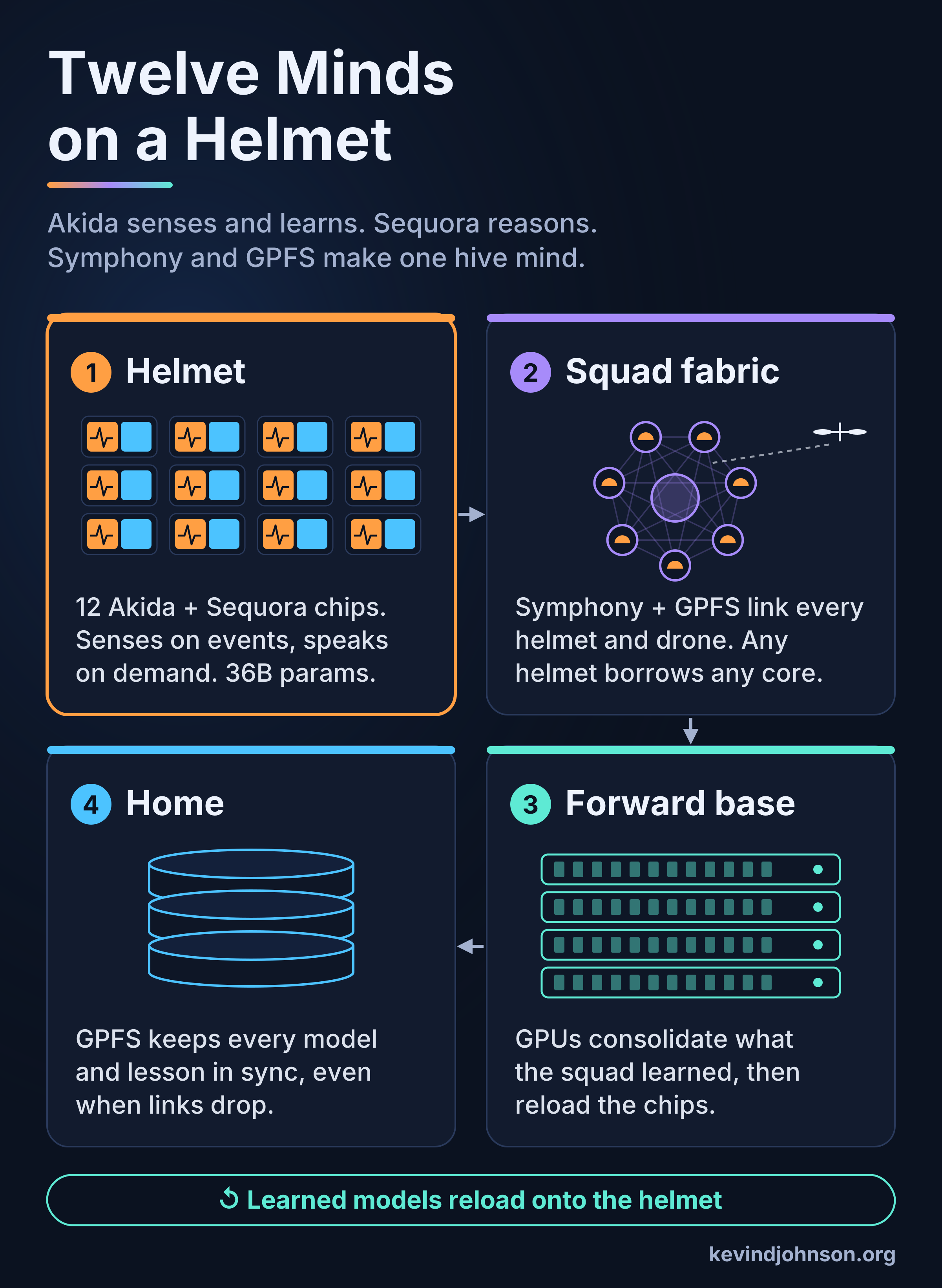
Drones add eyes overhead, as they did in SymSEAL and SymHelmet, and their sightings join the same consensus. Every part keeps its own nature and nothing is forced into a single shape.
Above the fabric sits a single serving interface, and that changes what a helmet is. I have already run Akida as a first-class vLLM backend behind the standard OpenAI-compatible API, hot-swapped a hundred models across the fleet, and served one vLLM endpoint from fifty-six nodes across three sites with models placed live. On a squad of helmets, the same approach means:
- Models load as the mission needs them. When a helmet’s sensors pick up a chemical hazard, a medical chip can swap in an exposure model, then swap back once the danger has passed. The twelve specialists are a starting lineup, not a fixed one.
- No helmet cares where its processing comes from. A request goes to the endpoint, and Symphony places it on whichever chip in the squad has the capacity and the right model loaded. A helmet saturated during contact borrows cores from a teammate whose helmet is quiet.
- The squad sees around corners. When the operator at the corner detects movement, Akida detects and the specialist’s reading reach every other helmet through GPFS as fast as the link allows, so the operator behind the wall knows what the operator at the corner sees.
- The fabric holds in a constrained environment. Symphony routes work over whatever paths remain, GPFS reconciles state when links recover, and a helmet cut off entirely keeps sensing, learning, and reasoning on its own until it rejoins.
That is tactical superiority built from architecture: a team that perceives, reasons, and shares as one.
The Vision, Carried Forward
Van der Made’s legacy is not a particular chip but a claim: that efficiency and intelligence come from computing the way brains compute, sparse, event-driven, and adaptive. The brain does not run everything on one kind of tissue, and it does not wait for a distant center before it acts. A mind senses, learns, and speaks from wherever it is.
A helmet carrying twelve minds that perceive with spikes, learn in place, and reason on demand would be that claim made wearable. The helmet becomes a participant in a living fabric, one voice in a neuromorphic hive mind of many minds that spans the squad, the drones overhead, the forward base, and home.
The pieces are already on the table. The AKD2500 tapes out in December. Sequora is now licensable. Symphony and GPFS already run the fabric, and van der Made’s full Higher Intelligence architecture already runs across Akida chips today. What remains is to put them together in the spirit in which BrainChip was founded: trained, not programmed; learning, not frozen; many minds, one neuromorphic hive mind.